
The State of Drones in Search and Rescue
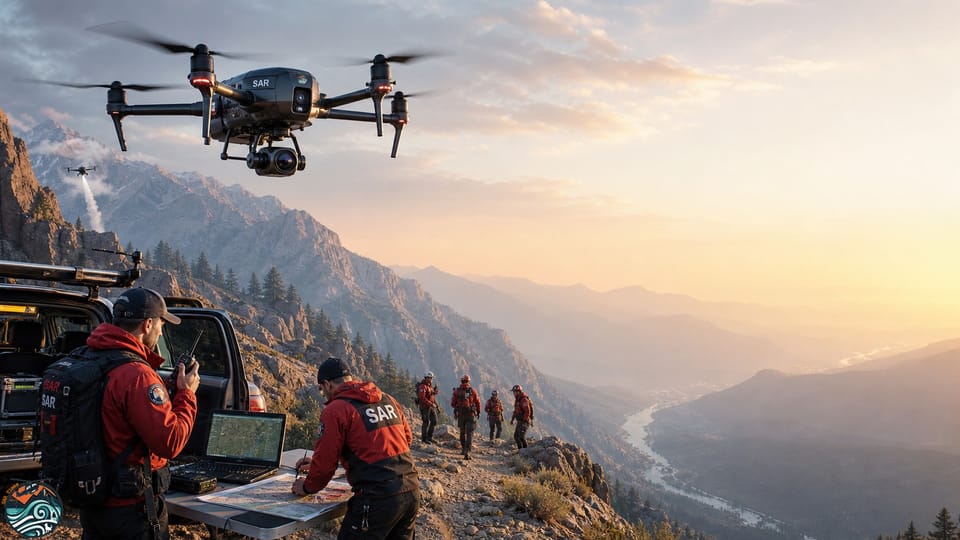
On May 27, 2026, MIT Lincoln Laboratory published details on ASCEND, an AI-based mission planner built specifically for drone search and rescue that generates flight paths while respecting regional airspace and regulatory constraints. The system uses agentic AI to handle the three core steps of mission planning: retrieve logistics data, reason against mission goals, and generate a compliant route. During testing, the agents successfully planned a flight from Biggs Airfield in Texas to the Rio Grande River while avoiding no-fly zones and altitude restrictions.
The project has already moved beyond research. In October 2025, MIT transitioned the work to the FAA-sponsored GUSTAVE program, which is developing agentically generated aircraft routes. The Office of the Under Secretary of War is also sponsoring an uncrewed systems program based on this work, with additional interest from Joint Interagency Task Force 401, the 101st Airborne, and the 75th Ranger Regiment.
This transition signals something important for SAR practitioners. The bottleneck is no longer whether drones can help in search operations. The question is whether agencies can turn them into a routine part of search planning, airspace coordination, and time-sensitive decision-making under real operational constraints.
Where Drones Actually Help in SAR Today
Professional SAR teams use drones for area coverage, thermal detection, shoreline and wilderness search, and incident mapping. The DJI Matrice 30 and Matrice 4T lead enterprise operations with 45-minute flight times and 640x512 thermal cameras, while the Autel Max EWO 4T offers dual thermal sensors for extended missions. The WingtraRay combines VTOL capability with fixed-wing endurance, delivering up to 59 minutes of flight time and coverage of 350 square kilometers per mission.
Thermal imaging remains a critical capability. A drone with an infrared camera is substantially more useful on a search because finding a person on a controller screen is surprisingly hard even in optimum conditions using visible light. During most summer days, natural objects reach nearly 100 F, which reduces contrast. In winter, a live subject against snow can blaze like a beacon in infrared. On cold, dark nights, the thermal camera is where the drone is most powerful.
Modern SAR drones integrate AI for human detection, which minimizes false positives by distinguishing human heat signatures from environmental sources. The DJI Matrice 4T uses dual-spectrum thermal imaging and AI algorithms to reduce false positives and allow teams to focus resources efficiently. Automated flight patterns facilitate systematic area coverage, letting rescue teams concentrate on data analysis rather than manual flight control.
Real-time situational awareness comes through live video streaming, GPS, and RTK positioning systems that provide precise victim location coordinates to command centers. Cloud-based mission planning and post-flight analytics improve operational efficiency, while mobile command centers with live video and mapping displays enable better resource allocation.
Drones also serve as communication relays in remote locations, extending radio coverage for ground teams. Some platforms support delivery of emergency supplies like food and medical kits directly to victims while ground teams mobilize.
The Hard Part: Constraints That Keep Drones From Scaling
The view from the field tells a different story from the capability lists. In New Mexico, flying a drone for a SAR mission requires a Part 107 pilot's license, which is a considerable undertaking and, for many volunteers, represents a barrier to participating. Most hobbyist drone operators don't have this certification, and the training required is substantial.
Beyond Visual Line of Sight operations present the biggest regulatory hurdle. Realistically, anything over approximately 0.5 miles will require BVLOS flight, which requires an FAA waiver. For SAR, teams use a Special Government Interest waiver because of the emergency nature of missions. However, the paperwork still requires pilot information, license numbers, drone registration, time windows, area of coverage, mission number, and event description. The FAA then establishes a Temporary Flight Restriction if the waiver is granted.
Professional SAR drones typically offer 30 to 50 minutes of flight time, with battery technology improvements continuing to extend these capabilities. This means multiple batteries are essential for anything beyond a small search area. The Los Alamos SAR team maintains a packing list that includes lots of batteries, a battery charger, and often a generator at Incident Base.
Weather resistance is essential but not universal. Top-tier SAR drones feature IP55 weather ratings and operate reliably in rain, snow, and winds up to 15 to 17 m/s, with temperature operating ranges from -20 C to 50 C. However, extreme conditions still pose operational limits, and teams need to check wind, visibility, and cloud ceiling before launch.
The operational reality includes coordination with manned aircraft. Drone pilots must be ready to put their drone down at a moment's notice if a helicopter shows up. Even with proper coordination protocols, things don't always adhere to ideals. The drone pilot cannot actively fly and speak on the radio simultaneously, so they might not answer when called. It pays to have practiced rapid return-to-base procedures and developed comfort with flying low.
Why Mission Planning Matters More Than Airframes
The MIT ASCEND work highlights a shift that many SAR teams haven't fully recognized. The original vision for the project was to create a drone mission planner for search and rescue operations that could abide by regional regulations. As the developer worked on the project, it evolved from retrieval-augmented generation to agentic AI, which builds on large language models to create agents that conduct multi-step tasks autonomously.
Currently, a trained expert handles mission planning and makes every decision involved in developing a flight plan. As drone operations scale up, experts could be required to plan hundreds or even thousands of missions, making it increasingly challenging for them to design each flight plan and recall what information was used for each route. ASCEND turned to AI solutions to overcome these issues, prototyping a team of agentic AI agents to complete the three steps of generating flight paths.
The system uses three agents working together: a manager agent that controls the team and announces task completion, a researcher agent that peruses the knowledge base, and a mission planner agent that generates the flight plan itself. This approach addresses the scalability problem that comes with expanding drone operations.
Daniel Stabile, an associate staff member in the Homeland Protection Systems Group, noted lessons learned during development. The size of the large language model really matters. He initially used a small model that was cheap and quick, but could not get it to work for mission planning. He switched to a more capable model that is slower and more expensive, revealing a trade-off between capability, speed, and cost.
Agentic AI is moving extremely fast, with new models, frameworks, and capabilities emerging weekly. This creates a challenge for organizations trying to keep pace with what's developing outside while maintaining operational stability.
What This Means for Public Safety Aviation
At the DRONERESPONDERS National Public Safety UAS Conference in March 2026, FAA Deputy Executive Director Paul Strande emphasized that drone technology has become an essential operational tool for emergency response agencies across the United States. These are not future state capabilities, he told the audience. They are current state realities.
Over the past decade, public safety drone programs have evolved significantly. Early adopters often relied on a single drone operated by a trained officer or firefighter for occasional missions such as crash reconstruction or missing-person searches. Today, many agencies operate fully developed aviation units with standardized training, dedicated pilots, and integrated workflows tied to emergency dispatch centers.
The FAA has been shifting from case-by-case operational waivers toward broader regulatory frameworks that provide clear and scalable pathways for agencies to operate drones. Early drone programs often depended on individual waivers issued by the FAA to authorize specific missions or operational parameters. While effective for early adopters, the waiver system could slow broader adoption and create uncertainty for agencies planning long-term programs.
BVLOS rulemaking remains a key focus. The FAA received more than 3,000 public comments during the initial comment period on the proposed BVLOS rule and reopened the comment period to allow additional input. The agency continues working toward a performance-based regulatory framework that will allow a wide range of operations while maintaining safety standards.
Integration with existing emergency dispatch and CAD systems allows seamless inclusion of drone operations into established protocols. Real-time data sharing among multiple drones and ground teams creates a unified operational picture, critical for coordinated SAR efforts.
The first unmanned rescue in combat
On June 8, 2026, while the FAA was still working through public comments on BVLOS rulemaking, Task Force 59 ran a different kind of field test. A U.S. Army AH-64 Apache was shot down off the Omani coast during Operation Epic Fury. Two crew members entered the water at roughly 3:30 a.m. local time. Within two hours, they had been located, transported to a pickup point by an unmanned vessel, and recovered by helicopter.
The vessel was the Navy Corsair, a 24-foot crewless surface vessel built by Saronic Technologies and first deployed to CENTCOM in March 2026. It carries a 2,500-nautical-mile range, 35-knot top speed, and a 3,500-pound payload capacity. What it did in June 2026 was complete a personnel recovery in a contested environment, without crew risk and fast enough to matter. Task Force 59 has characterized it as the first publicly reported rescue of downed aircrew by an unmanned vessel in actual combat operations.
The civilian and military development tracks are running separately, and the operational environments are different enough that the Corsair doesn't map directly onto wilderness or maritime SAR. But the record now includes an unmanned system locating survivors and getting them out, in a real operation, under real conditions. That's the kind of result that moves procurement priorities and accelerates regulatory attention.
Where the field goes from here
Two gaps are likely to define the next several years of SAR drone deployment, and neither is solved by better hardware.
The first is interoperability. Most public safety drone programs today are built around a single agency. A county sheriff's office has its platform, the fire department has its own, and the SAR volunteer team has theirs. When a major incident requires all three, sharing video feeds, flight corridors, and situational data across those systems in real time is harder than it sounds. Standards for cross-agency drone data sharing don't exist yet for most jurisdictions. Until drone data flows across agency boundaries as cleanly as radio channels are supposed to, multi-agency operations will keep relying on workarounds.
The second is the volunteer training gap. Part 107 certification is not easy to obtain, and for volunteer SAR teams, it represents a real barrier to building a viable drone program. A volunteer who wants to fly for their team needs to pass an FAA knowledge test, maintain currency, and complete SAR-specific training on top of that. The result is that many teams have one or two qualified pilots and no depth. When those pilots are unavailable, the drone sits. Better airframes don't fix this. The regulatory pathway has to get simpler, or agencies need to find ways to build certified pilot capacity faster than they currently are.
ASCEND and programs like it address a third constraint: mission planning at scale. But the people problem comes first. The most capable drone in the world doesn't help if no one qualified is available to fly it legally when the callout comes in.
References
Federal Aviation Administration. (2026, March 19). Part 107 Waivers. https://www.faa.gov/uas/commercial_operators/part_107_waivers
Lincoln Laboratory, MIT. (2026, May 27). Lincoln Laboratory technology generates flight paths with agentic AI. https://www.ll.mit.edu/news/lincoln-laboratory-technology-generates-flight-paths-agentic-ai
Los Alamos SAR. (2024, February 4). Drones in SAR. https://losalamossar.org/drones-in-sar/
McNabb, M. (2026, March 10). FAA highlights public safety drone growth at DRONERESPONDERS National Conference. DRONELIFE. https://dronelife.com/2026/03/10/faa-highlights-public-safety-drone-progress-at-droneresponders-national-conference/
Covered 6. (2025, November 11). Best search and rescue UAVs: Top unmanned aerial vehicles for emergency response 2025. https://www.c6drones.com/best-search-and-rescue-uavs-top-unmanned-aerial-vehicles-for-emergency-response-2025/
SOF News. (2026, June 8). Apache crew rescued by naval drone off coast of Oman. https://sof.news/drones/naval-drone-rescue/