
Eight Days in a Lifeboat: The Arctic's Uncomfortable Answer to "When Will Help Arrive?"
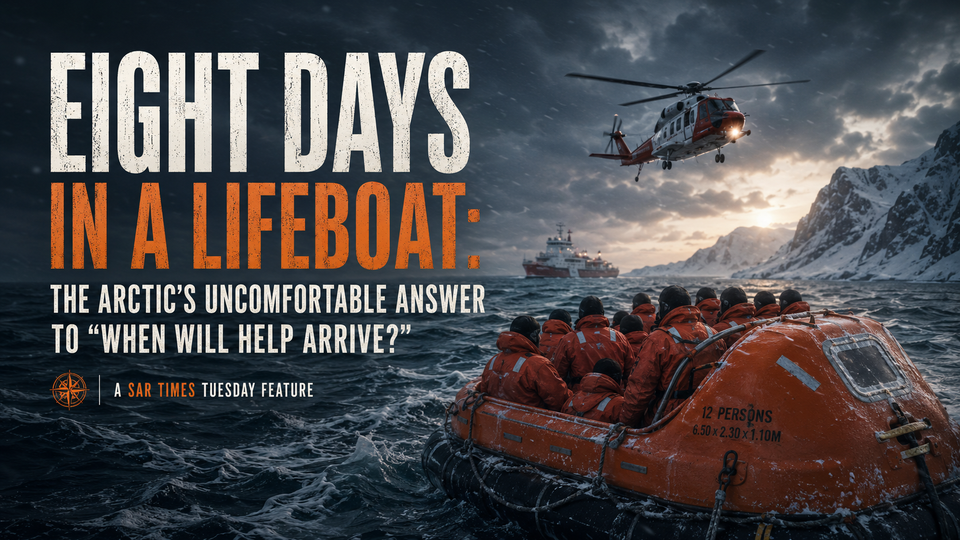
The nightmare scenario already happened once, and it happened in the best possible place.
On March 23, 2019, the cruise ship Viking Sky lost all four engines in a storm off Hustadvika, Norway, with 1,373 people aboard. Investigators later concluded she came within roughly a ship's length of grounding on a lee shore in nine-meter seas. Norway's Joint Rescue Coordination Centre threw six helicopters at the problem, and over roughly 20 hours, crews hoisted 479 passengers off the pitching deck one at a time. A peer-reviewed account in the medical literature called it "one of the most remarkable helicopter rescue operations ever."
Here is the detail that should keep every SAR planner awake: Hustadvika sits on the coast of one of the wealthiest, best-equipped SAR nations on earth, within easy reach of multiple helicopter bases, tugs, and hospitals. Even there, with everything close and everyone competent, they got fewer than 500 of 1,373 people off before conditions forced a stop, and the outcome ultimately depended on the ship's own engineers restarting a motor.
Now move that ship a thousand miles north, into the Northwest Passage in October. Who comes, and when?
A team of Canadian researchers has just published an unusually honest answer, and the SAR community should sit with it.
More ships, bigger ships, longer seasons
First, the traffic. According to the Arctic Council's PAME working group, 1,812 unique ships entered the Arctic Polar Code area in 2025, a record and a 40 percent increase since tracking began in 2013. Distance sailed has nearly doubled over the same period, to 11.9 million nautical miles. Cruise ship numbers are up 123 percent since 2013, and PAME's analysts note that the vessels themselves have grown, carrying more passengers farther into previously inaccessible waters as older, thicker ice disappears.
Every one of those ships operates under the IMO's Polar Code, in force since 2017, which requires operators to complete a risk assessment and produce a Polar Water Operational Manual. Buried in that process is a single number with enormous human consequences: the Maximum Expected Time to Rescue, or METR. It goes on the Polar Ship Certificate, and it answers a blunt question: how long must everyone aboard survive before rescue is realistically complete?
The problem, until now, has been that shipowners had little rigorous basis for choosing that number. Coast guards publish how quickly they can get a ship or aircraft moving, not how long it takes that asset to actually arrive across a rescue region that stretches to the North Pole.
Modeling the wait
That gap is what a multi-year Canadian project set out to close, and its findings were summarized last week for The Arctic Institute's 2026 Polar Disaster Series by Jack Gallagher of Hammurabi Consulting, together with Ronald Pelot, Floris Goerlandt, Kimia Mostaghimi, Robert Brown, and Peter Kikkert, drawing on work at Dalhousie, Memorial, and St. Francis Xavier universities with funding led by Canada's National Search and Rescue Secretariat.
The team's method deserves attention from anyone who plans SAR coverage anywhere. They divided Canadian Arctic waters into 361 grid squares of 100 kilometers each, modeled responses to the center of every square, and tested the results against the sixteen Shipping Safety Control Zones mariners already know. They fed in two years of AIS tracks to establish where potential rescue vessels actually are throughout the year, used the POLARIS ice-risk system to determine which ships can enter which ice, and set realistic transit speeds by ice class. They assumed worst case: the entire complement in survival craft, with the clock running from SAR notification until the last person is aboard a rescuing ship or helicopter.
Vessels of opportunity carry most of the weight in this model, because with so few Canadian Coast Guard ships across so vast an area, they have to. Under the model's rules, an ordinary vessel of opportunity can take on up to 50 survivors; a cruise ship in trouble needs another cruise ship or a coast guard vessel to answer.
Then they asked the people who do the work. The team ran workshops with controllers from the Joint Rescue Coordination Centres in Trenton and Halifax, RCAF rescue pilots and SAR technicians, coast guard mariners, and commercial crews, and participated in the Nunavut and Nunavik SAR Roundtables, where Inuit community responders and government partners meet. That last detail matters. In much of the Canadian Arctic, the nearest competent responders are not a federal asset at all; they are hunters and community members with boats, local knowledge, and generations of experience surviving the environment that a shipwrecked crew is about to meet for the first time.
What the helicopter crews said
The aircrew consultations produced some of the most sobering material in the study. Canada's SAR helicopters are all based in the south. For the most remote Arctic grid squares, the modeling showed transits requiring up to seven refueling stops, and every shutdown for fuel is another chance for a mission-critical component to refuse to restart. Where pressurized fueling isn't available, filling an aircraft from barrels at a remote cache can take up to three hours. Long missions require leapfrogging fresh crews north by fixed-wing aircraft to swap in mid-transit.
And once on scene, a helicopter's appetite is small. The pilots and SAR techs told the researchers their ideal mission is hoisting one or two people to a hospital, that complexity climbs sharply past six hoists, and that in their professional judgment any rescue of more than about 20 people should be a maritime operation with helicopter support. Yes, crews have pulled off heroic outlier missions with far higher counts, Viking Sky among them, but the experts were clear that outliers are not planning figures. The study set 24 persons as the ceiling for an all-helicopter rescue.
Fixed-wing SAR aircraft, for all their value dropping supplies, pumps, and medical support, cannot retrieve anyone. The study left them out of the rescue-time math entirely.
The numbers nobody wants on a brochure
So what should a ship's METR actually be? In the prime late-summer season, in the parts of the Arctic where shipping concentrates, the study found five days is a reasonable planning figure, largely because light ice and abundant vessels of opportunity shorten the wait. Even then, the high western Arctic never got down to five days; its best four-week window still modeled out at eight.
Outside the prime season the picture darkens quickly. The five-day figure holds a few extra weeks only in Hudson Bay, Hudson Strait, and the lower Arctic. As for the depths of winter, the authors are unambiguous: "using an METR of five days is not reasonable at all." Some zones modeled out to nineteen days, and the authors caution that in the worst cases even that number is theoretical, because no marine resource may be able to refuel and transit through prevailing ice at all.
Nineteen days. Read that as a SAR professional and then read it again as a human being: a certificate on a bridge in effect telling a crew, and possibly several hundred passengers, that the plan is to keep everyone alive in survival craft or on the ice for nearly three weeks, in darkness, at temperatures that kill the unprepared in hours.
This is also why the researchers had to redefine "rescued." The international SAR Convention speaks of delivering survivors to a place of safety, but the study notes that places of safety barely exist in the Arctic. A hamlet of a few hundred people cannot absorb a cruise ship's complement without its own food, sanitation, and medical capacity buckling. Survivors of a Canadian Arctic incident will typically remain in the SAR system's care until they are landed in southern Canada. The study's clock stops when the last person leaves the ship's resources, and everyone involved understands the mission is far from over at that point.
What this means beyond Canada
The specific numbers are Canadian, but the logic travels. The 2011 Arctic Council SAR Agreement tidily divided the circumpolar map into national areas of responsibility; it did not conjure hoisting capacity, ice-capable hulls, or fuel caches into any of them. Greenland, Svalbard, and the Russian and Alaskan Arctic all present versions of the same equation: traffic rising, assets distant, and vessels of opportunity plus local communities carrying the real burden of the first response.
For SAR Times readers, three takeaways stand out. First, METR-style modeling, grid-based, seasonal, ground-truthed with operators, is a template other remote-area SAR systems should replicate rather than admire. Second, the humble vessel of opportunity is the load-bearing wall of polar SAR, which means every fishing skipper, tug master, and expedition captain in high latitudes is a de facto SAR resource and deserves to be trained, exercised, and informed like one. Third, and hardest: the honest planning number for much of the Arctic, much of the year, is measured in days or weeks, and the first responders to the next polar disaster will be the survivors themselves, their crew, and whichever strangers happen to be nearest.
The full project report is available through the Maritime Risk and Safety research group, and the Arctic Institute piece rewards a complete read.
References
Arctic Council. (2025, May 12). Arctic shipping on the rise: What trends can tell us. https://arctic-council.org/news/arctic-shipping-what-trends-can-tell-us/
Arctic Council. (2026, February 12). Arctic shipping update: 40% increase in ships in the Arctic. https://arctic-council.org/news/increase-in-arctic-shipping/
Gallagher, J., Pelot, R., Goerlandt, F., Mostaghimi, K., Brown, R., & Kikkert, P. (2026, June 30). Ships in the Arctic need to plan to survive until help arrives. The Arctic Institute. https://www.thearcticinstitute.org/ships-arctic-need-plan-survive-until-help-arrives/
International Maritime Organization. (2016). Polar Code: International code for ships operating in polar waters (2016 ed.). IMO.
Large-scale helicopter rescue of cruise passengers and freighter crew off the coast of Norway in stormy weather. (2019). Injury. https://pubmed.ncbi.nlm.nih.gov/31237665/
Maritime Executive. (2019, November 13). Viking Sky came within a ship's length of grounding. https://maritime-executive.com/article/viking-sky-came-within-a-ship-s-length-of-grounding
Maritime Risk and Safety Research Group. (n.d.). Maximum Expected Time to Rescue (METR) project. https://www.maritimeriskandsafety.ca/projects/metr/
Shipping Telegraph. (2026, February 20). Arctic ship traffic hits record 40% increase in 2025. https://shippingtelegraph.com/shipping-news/arctic-ship-traffic-hits-record-40-increase-in-2025/