
SAR Times Weekly (11 Jun 2026)
Weekly Highlights
I tried to limit the amount of war-related SAR stories in an effort of normalcy, which is hard, I know. But that said, the drone rescue was too cool to pass up. I've got a few global stories for the rest, and a dable of policy for my fellow policy wonks.
This week on SAR Times, I posted a piece looking into the future of EPIRBs, When the Beacon Talks Back! IMO moves toward two-way distress communication for maritime EPIRBs. In short, an RCC will soon be able to "chat" back to someone in distress via their EPIRB.
And the front page of SAR Times had a small facelift and looks a little more inviting, in my opinion. As always, if you have a story to share, email me, and don't forget to share the newsletter with your fellow SAR community!
🔴 Cases & Operations
Apache crew recovered by US Navy drone in Gulf of Oman
A US Army AH-64 Apache went down off the coast of Oman on June 8, and both crew members were recovered within about two hours by a 24-foot US Navy Saronic Corsair unmanned surface vessel operating under Task Force 59, in what is believed to be the first publicly reported real-world recovery of downed aircrew by a naval drone. The USV located the pilots, ferried them to a position where a helicopter could hoist them, and demonstrated a new combat SAR modality in contested maritime airspace where sending crewed rescue platforms carries higher risk. For SAR doctrine, the case points toward mixed-fleet architectures where autonomous surface craft handle initial localization or survivor pickup in high-threat environments.
Magnitude 7.8 earthquake in southern Philippines triggers multi-hazard SAR operation
A major offshore earthquake struck near Sarangani province on June 7, generating a tsunami of up to 1.4 meters and triggering building collapses and landslides that have killed at least 35 people, injured more than 200, and left additional persons missing as of June 10. SAR teams in General Santos have been working a collapsed commercial structure under a heavy aftershock sequence that has included events up to magnitude 6.7, pulling multiple survivors and casualties from the debris while two people remain believed trapped. The operation is a live case study in multi-hazard SAR coordination, running tsunami warning and evacuation, structural collapse rescue, and landslide response simultaneously across a broad coastal region.
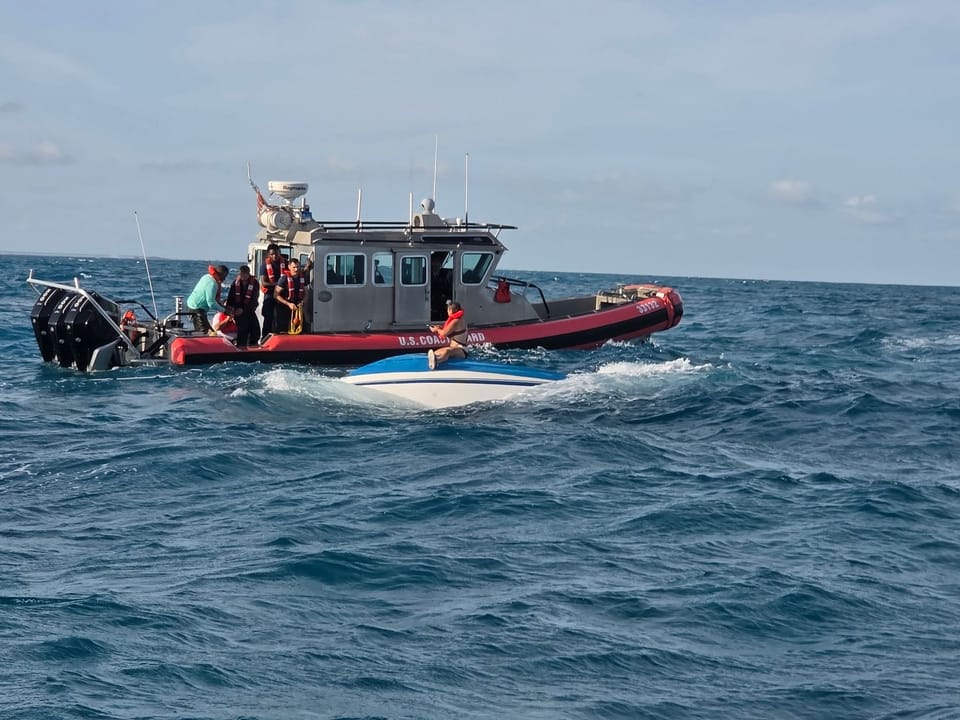
Three rescued after vessel capsizes near Little Palm Island, Florida Keys
Station Marathon recovered three boaters without injury after their vessel capsized roughly 5 miles south of Little Palm Island on June 8, following a 911 transfer from the Monroe County Sheriff that gave Sector Key West enough information to launch a small boat and locate the survivors quickly. The case is a clean example of 911-to-sector-to-station interoperability working as designed: the hull was anchored and a safety broadcast issued while the owner arranged commercial salvage. It also reinforces lifejacket wear and rapid shoreside notification as the two actions most likely to keep a capsize from becoming a fatality.
Multi-day swift-water search underway on Kern River near Lake Isabella
Kern County Sheriff's Search and Rescue and Kern Valley SAR teams have been conducting an extended search since June 6 for a man reported swept away in the Kern River, with operations continuing as of June 8. The Kern River is among California's highest-workload swift-water zones due to cold, fast water and heavy recreational use, and even single-victim searches in this corridor regularly commit highly trained teams for multiple days under hazardous conditions. A reminder ahead of the summer season that rivers in this category warrant early, aggressive public risk communication.
Looking for a way to standardize your team's Search and Rescue certifications? Join the International Association of Search and Rescue Coordinators as an organization and have a voice in setting international SAR standards.
Individual Memberships are nearly here, too!
📡 Technology & Innovation
Wave-powered buoy demonstrates persistent offshore SAR sensor coverage for US Coast Guard
Ocean Power Technologies reported that a MERROWS-equipped PowerBuoy deployed off San Diego under a DHS award for the US Coast Guard has generated close to 0.5 MWh of renewable energy while maintaining reliable operation in an active maritime environment. The wave-powered platform supports maritime domain awareness by powering persistent sensors and communications offshore without the logistics burden of fuel resupply or frequent servicing, a model that could augment conventional beacon, AIS, and radar sources used in initial distress detection and drift modeling.
Indonesia deploys multilingual trafficking-screening app to Basarnas and maritime agencies
The US Embassy in Jakarta announced completion of testing of PESISIR, a multilingual mobile application for Indonesian Marine and Air Police to screen fishing-vessel crews for human-trafficking indicators, with rollout planned to Basarnas and BAKAMLA. The app provides audio-based questionnaires in eight languages and structured documentation for case building, and its adoption by Basarnas will strengthen interagency information flows in the maritime operating picture across a region where SAR tasking and exploitation cases regularly intersect.
📋 Policy & Regulatory
IMO MSC 111 adopts SOLAS amendments requiring multi-satellite SAR dissemination
MSC 111 amended SOLAS IV and V to require that Maritime Safety Information and SAR-related data be disseminated through all operational Recognized Mobile Satellite Services, closing a gap that previously allowed single-provider coverage. The changes also tighten shipboard DSC distress procedures and enter into force on 1 January 2028, giving operators a multi-year window to update systems and training.
India and Australia commit to joint SAR exercise at MRCC Chennai
Following their second Defence Ministers' Dialogue, India and Australia announced a joint SAR and tabletop exercise at MRCC Chennai in June 2026, creating a ministerial-level mandate for bilateral SAR coordination practice in the Indian Ocean region. It is the first formalized bilateral SAR exercise commitment between the two countries and a meaningful step toward interoperability for maritime incidents in a strategically active area.
Rep. McDonald Rivet calls for resources to restore 24/7 coverage at Saginaw River Coast Guard Station
Representative McDonald Rivet issued a press release noting that staffing cuts over the past two years have eliminated around-the-clock SAR coverage from the Saginaw River Station, a unit serving a high-traffic Great Lakes recreational and commercial waterway. The statement reflects the broader tension between service-wide Coast Guard manpower constraints and community expectations of continuous rescue readiness in historically covered regions, a conversation happening in multiple districts.
🤔 Other News
Tennessee awards first state US&R credential to Task Force 2
TEMA awarded Tennessee Task Force 2 the state's first Urban Search and Rescue credential, formally recognizing the Nashville-based multi-agency team as a specialized statewide response asset for structural collapse, flooding, and similar complex rescue incidents. The team can now deploy statewide or interstate via EMAC, and Tennessee joins the list of states with a formally credentialed US&R task force.
Northwest PA K9 Search and Rescue hosts GET LOST 5K fundraiser
The Northwest PA K9 Search and Rescue Team held its GET LOST 5K at Harborcreek Community Park on June 6, combining a road race, kids' dash, and dog-friendly category with proceeds going directly to the volunteer unit's operations. Beyond fundraising, events like this build the community ties and public visibility that sustain volunteer SAR organizations running entirely on donated time and resources.
🤓 And Now You Know
On June 15, 1904, the steamboat General Slocum caught fire on the East River in New York City while carrying more than 1,300 passengers, mostly women and children from St. Mark's Evangelical Lutheran Church on a summer excursion. Over 1,000 people died, making it the deadliest disaster in New York City history until September 11, 2001. The inquiry that followed exposed every failure mode in maritime life-safety: life preservers packed with rotted cork and iron weights, fire hoses that crumbled on contact, and crew with no emergency training. The disaster drove the first major overhaul of U.S. passenger vessel safety regulations, including mandatory equipment inspections, and helped establish the principle that certifying equipment as seaworthy requires periodic verification, not just initial approval.
Have a story or some information you'd like posted in the SAR Times Weekly Newsletter? You can reach me via email anytime.