When the Beacon Talks Back! IMO moves toward two-way distress communication for maritime EPIRBs
A work item at this June's NCSR 13 session signals the next fundamental shift in how SAR authorities and survivors in distress interact at sea

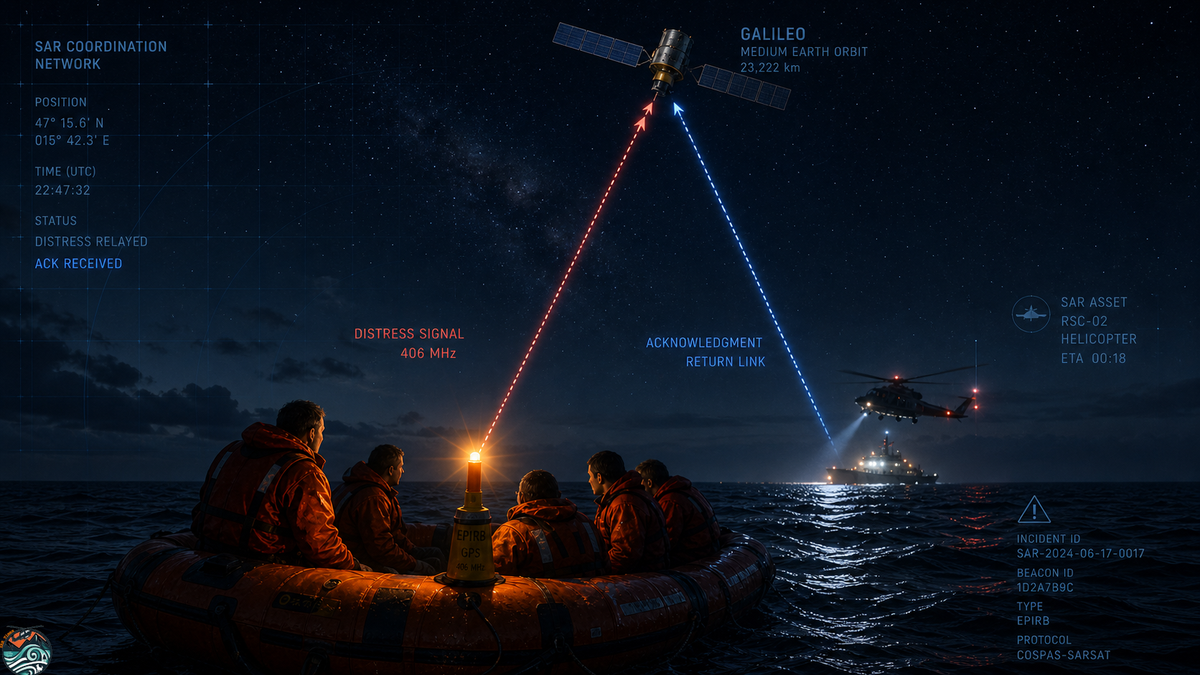
For more than forty years, the Emergency Position-Indicating Radio Beacon, more commonly known in these parts as an EPIRB, has operated on a simple, one-directional principle: you activate it, a satellite hears it, and help moves toward you. You get no confirmation. You have no way to tell rescuers whether the emergency is ongoing, who is injured, how many people are aboard, or whether the situation is deteriorating. The beacon broadcasts. The silence answers.
That model is about to change.
At IMO's Sub-Committee on Navigation, Communications and Search and Rescue (NCSR) 13th session, scheduled for 22-26 June 2026 in London, delegates will advance work on document NCSR 13/8/1, a paper developing guidelines for EPIRBs that incorporate Two-Way Communication (TWC) via the SAR/Galileo Return Link Service (RLS). If the guidelines progress as expected, the next generation of maritime distress beacons will call for help, receive messages from rescue coordination centers, confirm the distress, and exchange structured information in real time.
For SAR coordinators and maritime authorities, this is a doctrinal shift in how RCCs interact with survivors in the water.
How we got from LEOSAR to RLS
The Cospas-Sarsat system that underpins maritime distress alerting has been operational since 1982, when four nations (the United States, the Soviet Union, Canada, and France) launched a cooperative satellite program to detect 406 MHz distress signals and relay them to rescue authorities. The original architecture relied on Low Earth Orbit satellites (LEOSAR), which provided global coverage but with detection delays of up to 90 minutes depending on satellite geometry.
The shift to Medium Earth Orbit Search and Rescue (MEOSAR) changed that. By incorporating dedicated SAR payloads aboard navigation constellations (the European Galileo, GPS, GLONASS, and BeiDou systems), MEOSAR enabled near-instantaneous global detection of 406 MHz distress signals. Galileo's SAR Forward Link service went operational in 2016, leveraging the 30-satellite constellation to relay distress signals to ground processing centers and on to rescue coordination centers in seconds rather than minutes.
But distress alerting still only flowed one way.
The return link is Galileo's unique contribution
The SAR/Galileo Return Link Service (RLS), declared operational in 2020 and achieving Full Operational Capability in October 2024, introduced something no other GNSS constellation offers: an automatic acknowledgment message sent back to an activated beacon. When an RLS-compatible EPIRB, PLB, or ELT fires and the signal is processed, the beacon receives a return signal confirming that the distress alert has been received and the user's position computed.
Five years of operational data have validated the service. The RLS has maintained 99.99% availability since launch, and the average time to deliver an acknowledgment to an activated beacon is 37 seconds, dramatically better than the 15-minute target. EUSPA, the EU Agency for the Space Programme, estimates that the full Galileo SAR contribution helps Cospas-Sarsat save more than 3,000 lives annually.
The psychological dimension has its own operational weight. A person floating in open water after a vessel casualty who activates their EPIRB and receives a visible confirmation signal (a flashing LED sequence or display indicator confirming receipt) experiences a measurable reduction in panic. EUSPA has noted that this reassurance effect demonstrably improves survival behavior by reducing the impulse to deactivate and reactivate the beacon repeatedly, which disrupts SAR triangulation and RCC situational awareness. The Return Link proved the infrastructure. Two-Way Communication is now the next step.
What two-way communication actually means
The operational value is real. Consider a MAYDAY situation involving a vessel with a crew of twelve. The Rescue Coordination Center (RCC) receives an EPIRB activation position. Under current practice, the RCC knows the beacon's registered vessel, its approximate position, and nothing else until a helicopter arrives on scene or a nearby vessel raises contact. With TWC, the RCC could query the beacon immediately: Is the vessel sinking? How many persons are in the water? Are there injuries? Is the vessel still afloat?
The answers shape the entire response posture, including asset selection, medical pre-positioning, secondary search patterns, priority sequencing when multiple incidents compete for the same resources, to name a few.
TWC does not mean voice communication. The system under development uses the existing Galileo forward and return link channels to support structured, pre-defined message exchange between an RCC and an activated beacon. A rescue coordination center using a web interface can send questions to a TWC-capable beacon; the beacon user responds using a limited set of pre-defined options.
EUSPA is also developing a parallel capability called Remote Beacon Activation (RBA), which would allow authorized authorities to remotely activate a beacon in a man-overboard or incapacitation scenario where the survivor cannot self-activate. Both TWC and RBA are funded through a €3.5 million EU development contract, with the integration and testing of at least one operational prototype underway as of 2025.
The IMO policy track and where NCSR 13/8/1 fits
The IMO's work on TWC-capable EPIRB guidelines has a traceable policy history. In May 2023, the Maritime Safety Committee at its 107th session (MSC 107) agreed to develop guidelines for EPIRBs incorporating the TWC service via the Return Link, framing the new guidance as a complement to the existing EPIRB performance standard, IMO Resolution MSC.471(101), which entered into force for all SOLAS vessels on 1 July 2022.
MSC.471(101) established mandatory requirements for GNSS receivers and AIS transmitters in float-free EPIRBs. It also laid technical groundwork compatible with RLS functionality, though RLS integration remains optional under current standards. NCSR 13/8/1 represents the next layer by turning that optional compatibility into a defined, standardized operational capability with guidelines that specify how TWC-enabled EPIRBs interact with rescue coordination centers.
The June 2026 NCSR 13 session will not produce final standards. IMO develops guidelines through an iterative working group and correspondence group review, with final adoption by the MSC typically following one to two further cycles. What NCSR 13 is expected to produce is a worked draft of the guidelines, resolution of key technical and procedural questions, and a clear timeline for completion. Shipowners, maritime administrations, and beacon manufacturers should treat NCSR 13/8/1 as the regulatory development marker (the point at which the IMO's direction becomes legible) rather than an immediate compliance event.
What this means for SAR practitioners and maritime administrators
EPIRBs are moving from passive distress transmitters to interactive survival communication tools. For SAR professionals, that shift has three near-term implications worth tracking now:
RCC workflow will need updating. The operational procedures governing how RCCs handle EPIRB alerts were written for one-way alerting. When TWC becomes standard, those procedures will require revision, covering who has authority to query a beacon, what message sets are approved for use, how responses are logged and routed, and how TWC data integrates with existing SAR coordination software. Organizations with RCC responsibilities should begin internal scoping of those gaps now rather than waiting for the standards to finalize.
Vessel operators will face fleet upgrade cycles. TWC capability is not backward-compatible. RLS-enabled EPIRBs require hardware that the prior generation does not include; TWC beacons will require further hardware beyond current RLS models. The IAMSAR Manual and flag-state SOLAS enforcement cycles will eventually require TWC-capable devices, though the timeline remains to be established. The commercial beacon market is already moving. Second Generation Beacons (SGBs) built to Cospas-Sarsat specification T.018, with native MEOSAR and RLS support, are anticipated to reach commercial maritime availability in the near term.
Training doctrine will lag the technology. The gap between capability deployment and doctrine update is a persistent structural problem in maritime SAR. EPIRBs that can communicate create survivor behavior questions that current training does not address. For instance, what should a person in a life raft do when the beacon flashes a return link acknowledgment? What does it mean if no return appears? How do survivors respond to TWC queries when injured, disoriented, or in darkness and high sea states? The answer to those questions belongs in GMDSS training and SOLAS safety familiarization curricula. The sooner SAR training organizations begin working on updated guidance, the smaller the doctrine lag when TWC devices begin appearing on vessels.
The longer view
The EPIRB has been one of the most effective pieces of SAR technology ever deployed. From its first generations in the 1970s through the Cospas-Sarsat digital 406 MHz standard, through MEOSAR, and now the Return Link and Two-Way Communication development, the device has followed the same direction of being more accurate, faster, and more informative with each generation. The shift to TWC closes the last major information gap in the survivor-to-rescuer communication chain.
What remains to be determined is how quickly IMO can finalize the guidelines, how flag states will implement them, and how fast the beacon market will deliver compliant hardware at scale. NCSR 13 in June is the next decision point. SAR Times will follow the meeting outcomes and report on what the working group produces.
SAR Times covers global search and rescue policy, operations, and technology for practitioners, coordinators, and policy professionals. All IMO meeting outcomes referenced above reflect publicly available pre-session documents and working group scope; final session results will be reported following the June 2026 NCSR 13 session.
References
European Union Agency for the Space Programme (EUSPA). (2025, February 6). Galileo SAR Return Link Service celebrates five years of saving lives. https://www.euspa.europa.eu/newsroom-events/news/galileo-sar-return-link-service-celebrates-five-years-saving-lives
European Union Agency for the Space Programme (EUSPA). (2025, March 28). 406MHz emergency distress beacons with extended Galileo Return Link features. https://www.euspa.europa.eu/newsroom-events/news/406mhz-emergency-distress-beacons-extended-galileo-return-link-features
European GNSS Service Centre (GSC Europa). (2024). Search and rescue (SAR) / Galileo service. https://www.gsc-europa.eu/galileo/services/search-and-rescue-sar-galileo-service
IASARC. (2025). The global search and rescue (SAR) system. International Association of Search and Rescue Coordinators. https://www.iasarc.org/articles/the-global-search-and-rescue-system
IASARC. (2025, October 8). Why coordination? The most neglected component of search and rescue. International Association of Search and Rescue Coordinators. https://www.iasarc.org/articles/why-coordination-the-most-neglected-component-of-search-and-rescue
International Maritime Organization. (1979). International Convention on maritime search and rescue. IMO. https://www.imo.org/en/about/conventions/pages/international-convention-on-maritime-search-and-rescue-(sar).aspx
International Maritime Organization. (2022). Resolution MSC.471(101): Performance standards for float-free emergency position-indicating radio beacons (EPIRBs) operating on 406 MHz. IMO. https://www.imo.org
Jotron. (2024, November 5). The history of the EPIRB. https://jotron.com/history-epirb/
Lloyd's Register. (2022, April 12). Revised performance standard for EPIRBs and VDRs. https://www.lr.org/en/knowledge/class-news/06-22/
NOAA SARSAT. (n.d.). Cospas-Sarsat system overview. National Oceanic and Atmospheric Administration. https://www.sarsat.noaa.gov/cospas-sarsat-system-overview/
SAR Times. (2025, May 23). Shifting SAR responsibility: NGOs vs. states in the Mediterranean. https://sartimes.com/2025/05/24/shifting-sar-responsibility-ngos-vs-states-in-the-mediterranean/
Seas of Solutions. (2022). Return Link Service (RLS). https://www.seasofsolutions.com/resources/return-link-service
USCG / NOAA. (2024, May). Report on GMDSS and related activities: BMW 2024 update. https://www.sarsat.noaa.gov/wp-content/uploads/2024-BMW-GMDSS_USCG-Report.pdf