
SAR Times Weekly (25 Jun 2026)
Weekly Highlights
This week, I published two pieces on the site.
Tuesday's article, The State of Drones in Search and Rescue, is an attempt to make sense of where drone technology actually stands for operational SAR teams right now. The announcements are constant. The actual capabilities are more specific than the press releases suggest, and the regulatory and coordination gaps are still real.
Wednesday's special post, The Changing Landscape of Volunteerism in Search and Rescue, is one that anyone running or managing a SAR volunteer program should read. A UK Court of Appeal ruling from January confirmed that Coastguard Rescue Officers are legally workers whenever they receive pay for attending incidents or training, regardless of how their handbooks classify them. The ruling is binding in England and Wales, but the legal reasoning is not a UK-specific problem. If your organization pays members anything for showing up, this judgment has something to say to you.
The Policy section also covers the EU Screening Regulation, which took effect on June 12. It does not change how SAR operations run at sea, but it creates a formal legal link between rescue and border management on European coasts. Worth knowing if you follow the intersection of maritime SAR and migration policy.
🔴 Cases & Operations
Coast Guard Hoists Injured Hiker From Mount Larrabee With Less Than Ten Minutes of Fuel on Scene
A Coast Guard MH-65 Dolphin from Air Station Port Angeles evacuated a 33-year-old hiker from Mount Larrabee on June 24 after she fell approximately 120 feet down a steep gully on the south face and could not self-rescue. Washington State Emergency Management requested Coast Guard support due to terrain, altitude around 6,700 feet, and fading light. The hoist was completed with less than 10 minutes of fuel remaining on scene, a margin that reflects both the distance from base and the time required for precision work at altitude.
Child Found Deceased in Lake Michigan After Extensive Search; Four Responders Injured
A child who disappeared after entering Lake Michigan off an Indiana beach on June 22 was found deceased following a multi-agency, multi-day search in high surf and hazardous currents. Four first responders were injured during the operation. Great Lakes near-shore rescues in surf conditions are among the most dangerous environments for responding crews, and this incident is a direct example of the tension between aggressive rescue posture and operator safety that agencies continue to work through in high-energy water environments.
Drone Operators Locate Teen in Dense Woods Near Corbett, Oregon After Two-Hour Search
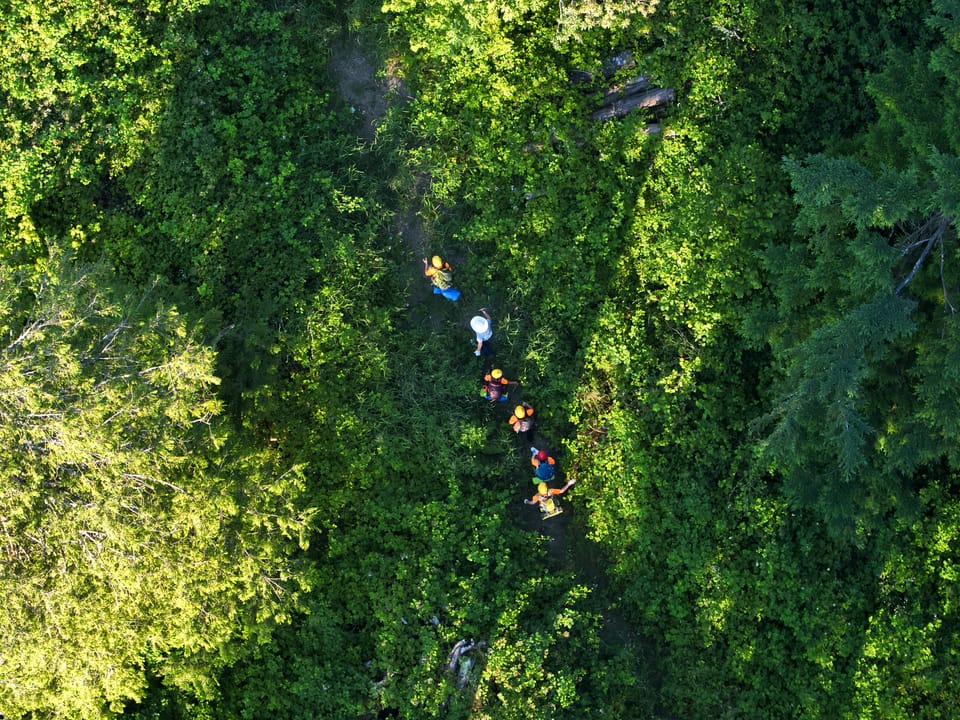
Multnomah County Sheriff's Office deputies and SAR volunteers located a 14-year-old who had walked into dense forest and blackberry thickets near his home in Corbett and could not self-extricate. Drone operators found his position from the air; ground teams cut through the brush to reach him. Total time from 911 call to walking out was about two hours. In terrain where vegetation blocks line-of-sight from the ground, small UAS can compress search time significantly, and this case is a clean example of that.
Garmin SOS Activation Leads Deschutes County SAR Directly to Subject in Remote Backcountry
Deschutes County 911 received a Garmin emergency activation at 7:14 p.m. on June 22 for a 66-year-old man from Nampa, Idaho, in remote backcountry. SAR teams responded directly to the GPS coordinates the device transmitted, located the subject, and provided assistance. The case is another data point in the shift toward satellite-based SOS devices as the primary detection mechanism for solo and remote travelers - shortening both detection and localization cycles compared to delayed notification through other channels.
Hiker Found Safe After Three-Day Search in Western Shasta County
A 35-year-old hiker, Gerrad Esnault, was found safe on June 24 in the Stoney Gulch Trail area of western Shasta County after going missing June 21 near the Swasey Park trail system. Community members located him; he reported becoming lost and was transported with minor injuries. Three-day missing-person operations in complex trail networks often turn on community involvement after formal search resources have been committed across multiple operational periods, and this case followed that pattern.
Looking for a way to standardize your team's Search and Rescue certifications? Join the International Association of Search and Rescue Coordinators as an organization and have a voice in setting international SAR standards.
Individual Memberships are nearly here, too!
📡 Technology & Innovation
The State of Drones in Search and Rescue
MIT Lincoln Laboratory's ASCEND system, now part of the FAA-sponsored GUSTAVE program, uses agentic AI to generate legally compliant drone flight paths for search and rescue missions, handling airspace logistics, mission goals, and route generation in sequence. The article traces where drone SAR currently stands, from enterprise thermal platforms and AI-assisted human detection to regulatory bottlenecks and the remaining barriers to routine operational use. The question is no longer whether drones can help but whether agencies can integrate them as standard search tools under real operational constraints.
📋 Policy & Regulatory
The Changing Landscape of Volunteerism in Search and Rescue
A January 2026 Court of Appeal ruling in Maritime and Coastguard Agency v Groom confirmed that UK Coastguard Rescue Officers are legally workers, not volunteers, whenever they receive pay for attending training or incidents, regardless of what their handbooks say. The ruling is binding in England and Wales, but its reasoning tracks a common-law pattern that applies across jurisdictions, and any SAR organization that pays members for attendance needs to read this judgment. The full article lays out the legal architecture and what it means for organizations running hybrid paid-volunteer models.
EU Screening Regulation Takes Effect, Formalizing Post-SAR Processing
The EU Screening Regulation took effect June 12, 2026, creating a mandatory processing phase for people brought ashore following maritime search and rescue operations, covering identity checks, vulnerability assessments, and security screening before referral into national procedures. The regulation does not alter how SAR operations run at sea, but it establishes a legal link between rescue and border management that changes how SAR authorities coordinate with border police in coastal EU states. Frontex is running implementation workshops through 2026.
🤔 Other News
Coast Guard Rescuer From Camp Mystic to Receive Pat Tillman Award for Service at ESPYs
ESPN announced that Coast Guard rescue swimmer Scott Ruskan will receive the 2026 Pat Tillman Award for Service. Ruskan was credited with helping save the lives of 165 people trapped at Camp Mystic during the Texas Hill Country floods last year. The award has historically gone to military service members; this year's selection puts the SAR community in front of a major sports audience in a way that almost never happens.
Dogs Take Home Top Prize at New Zealand Search and Rescue Awards
Handler-dog teams were among the top honorees at New Zealand's annual Search and Rescue Awards, which celebrate contributions to SAR operations across the country's volunteer and professional teams over the past year. Dog teams remain one of the most deployable assets in wilderness and urban search, and recognition at the national level tends to reflect what agencies are actually depending on in the field.
Saronic Autonomous Vessel Rescues Downed Helicopter Crew in Strait of Hormuz
[This was in last week's newsletter too, but here is some more information on the ordeal.] An American AH-64 Apache defending shipping in the Strait of Hormuz was struck by an Iranian Shahed drone in early June and crashed into the sea. Two crew members survived and were left floating in the strait for two hours before being recovered by a Saronic autonomous surface vessel - an unmanned boat operating without a crew aboard. The rescue is the first publicly documented combat-zone recovery performed by an autonomous surface vehicle, and Saronic, currently working toward an IPO, has been citing the mission as a proof-of-concept for its technology.
🤓 And Now You Know
On June 23, 2018, eight years ago this week, twelve members of the Wild Boars youth football team and their coach entered the Tham Luang cave complex in Chiang Rai Province, Thailand, for what was expected to be a short post-practice visit. Monsoon rains arrived early and flooded the passages behind them, sealing all 13 inside a chamber 2.5 kilometers from the entrance. The rescue operation that followed drew more than 10,000 personnel from Thailand, the United States, Australia, the United Kingdom, China, and a dozen other countries, and ended 17 days later with all 13 alive. The mission is now a standard case study in confined-space rescue coordination, specialist volunteer integration, and international operational command under extreme time pressure and public scrutiny. The extraction was carried out by cave divers, largely volunteers operating outside the formal rescue structure, and that fact alone has continued to generate questions about how SAR systems incorporate specialist capability that sits well outside normal credentialing frameworks.
Have a story or some information you'd like posted in the SAR Times Weekly Newsletter? You can reach me via email, anytime.