
When the Monster Arrives: Is Anyone Ready?
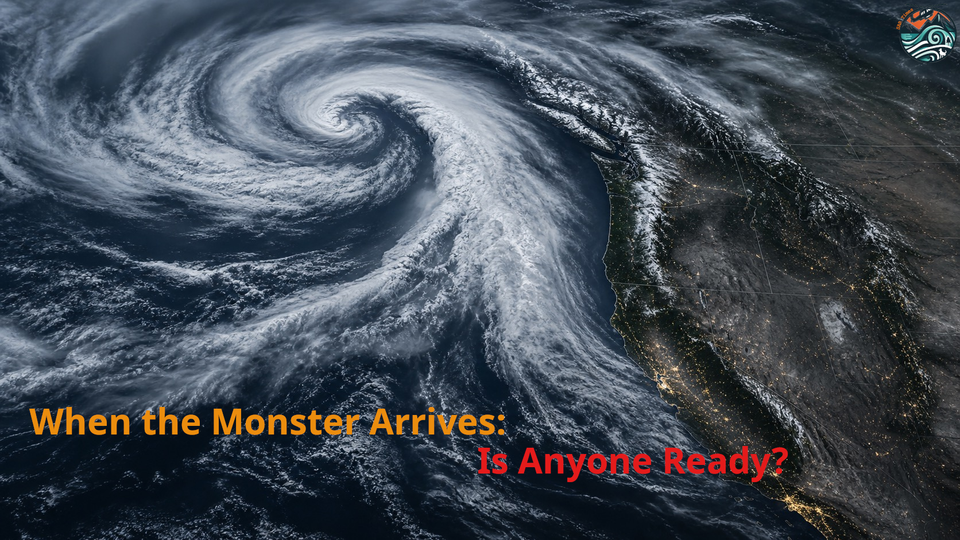
A potentially historic climate event is taking shape in the Pacific Ocean. If forecasters are right, the consequences for search and rescue operations along the western coastline of North America could be severe. That threat is arriving precisely when the nation's emergency management backbone is at its weakest.
Climate scientists aren't using cautious language anymore. The El Niño now developing in the Pacific, expected to emerge fully between May and July 2026 and peak around late 2026 to early 2027, may be among the strongest ever recorded. NOAA's Climate Prediction Center assigns a 61% probability of El Niño conditions emerging by mid-summer, with a one-in-four chance of reaching "very strong" intensity (Niño-3.4 index >= +2.0°C) by winter. Some climate scientists have already coined terms like "Super Duper El Niño" and "Godzilla El Niño." Noted science writer David Wallace-Wells argues in the New York Times that the event could rival or surpass the catastrophic El Niño of 1877, a climate episode so devastating it reshaped entire civilizations.
For the U.S. West Coast, this is already a forecast with a timeline.
What it means for the West Coast and SAR
From British Columbia down through Washington, Oregon, and California, the effects of a powerful El Niño follow a well-documented pattern:
- Atmospheric rivers and flooding: El Niño supercharges storm tracks across the Pacific, funneling intense rainfall events into the West Coast. In December 2025, before El Niño had even formally developed, back-to-back atmospheric rivers triggered record flooding across western Washington and British Columbia, prompting mandatory evacuations for up to 100,000 residents, and requiring California to deploy swift water rescue teams and three Urban Search and Rescue task forces northward.
- Landslides and debris flows: Heavy, sustained rainfall on fire-scarred terrain is a deadly combination. Southern California faces a higher risk of flooding, debris flows, and coastal erosion from a super El Niño winter. The same applies to slopes burned in recent wildfire seasons across Oregon and Washington.
- Coastal erosion and sea-level surge: Warmer Pacific waters elevate sea levels along the coast and generate larger wave action, compounding flood risk in low-lying coastal communities from Vancouver Island to San Diego.
- Wildfire, the paradox: In the Pacific Northwest, El Niño tends to produce a drier, warmer pattern rather than a wetter one. That means the Pacific Northwest fire season could extend, driving wildfire evacuations and wilderness SAR missions simultaneously, while Southern California floods.
- Swift water SAR demand spikes: When rivers flood, roads wash out, and communities become isolated, ground SAR transitions rapidly to swift water and air rescue operations. These are resource-intensive and technically specialized, especially in mountainous terrain across the Cascades and Sierra Nevada.
The 1982-83 El Niño, one of the strongest on record, dumped 34 inches of rain on downtown Los Angeles alone, more than twice the annual average. A 2026-27 event of equal or greater intensity would generate a cascade of simultaneous SAR demands across a coastal corridor stretching over 1,500 miles.
This site, by its namesake, is partial to anything related to SAR. And what would be a national-level SAR event without FEMA? Which, in itself, may be an issue. A super El Niño is arriving precisely as FEMA's workforce reaches its lowest point in years.
- FEMA's workforce dropped from approximately 29,000 employees in early 2025 to roughly 23,000 by year's end, a loss of over 6,000 staff in a single year.
- On New Year's Eve 2025, FEMA issued non-renewal notices to key members of its CORE workforce (Cadre of On-Call Response and Recovery), the teams that form the first federal boots on the ground following a disaster. CORE employees make up roughly 40% of FEMA's operational staffing.
- The administration's FEMA Review Council has proposed cutting the agency's total workforce by 50%, more than 12,000 positions, most of them in frontline disaster response.
- The administration's FY27 budget proposes cutting FEMA non-disaster grant programs by $1.3 billion, directly reducing state and local preparedness funding. These very programs fund local SAR training, equipment, and surge capacity.
- As of May 2026, FEMA has begun bringing some CORE employees back ahead of hurricane season, but only under court pressure and congressional scrutiny, not as part of any coordinated readiness plan.
The GAO reported that at the start of the 2025 hurricane season, FEMA's incident management workforce was already stretched to the breaking point, with 710 open disasters still receiving federal support. A super El Niño won't wait for FEMA to finish reorganizing.
A bipartisan congressional spending bill has attempted to block the most extreme cuts, requiring FEMA to maintain staffing levels "sufficient to fulfill the missions" required by law and preventing the closure of regional offices. The legislative guardrails are narrow, however, and the underlying trajectory of workforce reduction has not reversed.
The capability gap and SAR readiness
What December 2025 made clear is that states are already filling federal gaps through mutual aid. California deployed SAR assets to Washington rather than relying on a coordinated federal response. Interstate mutual aid is a legitimate part of the emergency management architecture. But it has limits. If California is simultaneously managing flooding in the Central Valley, landslides in the Angeles National Forest, and coastal surge in San Diego, it cannot also act as the backstop for Oregon and Washington.
The International Association of Emergency Managers has called the proposed FEMA cuts "deeply alarming," warning they would "effectively dismantle core programs" at a time when communities face "more frequent, complex, and costly threats." That's measured bureaucratic language for what SAR practitioners already understand: you cannot surge capacity you didn't build.
If a super El Niño delivers on its forecast, and the probability is rising, the following questions need answers before the rain starts:
- Is your team certified for swift water operations? Flood SAR is technically distinct from wilderness or urban SAR. Check your team's current certifications against projected mission types.
- Do your mutual aid agreements extend to neighboring jurisdictions and states? Given federal capacity constraints, regional coordination will be the operational reality.
- Is your equipment staged and waterproofed? Communications gear, boats, PPE, and medical supplies need to survive the same weather you're operating in.
- Do you have air asset MOUs? In a major El Niño event, roads will be impassable. Helicopter and hoist operations become primary, not secondary, SAR tools.
- Is your incident command structure ready for sustained operations? A super El Niño doesn't generate one incident. It generates dozens simultaneously, across weeks.
The bigger picture
David Wallace-Wells writes that El Niño doesn't simply create disasters. It "punishes those who have been made most vulnerable." That framing applies at every level of scale. To communities built on floodplains, to counties whose emergency management budgets depend on federal grants that no longer exist, and to SAR teams asked to do more with less.
The monster is building. The only open question is whether the system will be ready when it arrives.
SAR Times will continue to monitor El Niño development, FEMA capacity, and regional SAR preparedness as the season progresses. If your organization is updating protocols or training for El Niño conditions, we want to hear from you.
References
ABC7. (2026, April 28). Climate Prediction Center forecasts El Niño year, raising questions about flooding and rain in Southern California. ABC7. https://abc7.com/post/climate-prediction-center-forecasts-el-nino-year-raising-questions-flooding-rain-southern-california/18997
Associated Press Coalition for Professional Development in Emergency Coordination. (2026, March 26). FEMA workforce cuts exacerbate regional response gaps [LinkedIn post]. LinkedIn. https://www.linkedin.com/posts/acpdc
Axios Portland. (2026, April 14). Strong El Niño could worsen Northwest fire season. Axios. https://www.axios.com/local/portland/2026/04/14/el-nino-wildfire-risk-drier-season-forecast
E&E News. (2026, January 20). Budget plan would stymie Trump's FEMA cuts. E&E News. https://www.eenews.net/articles/budget-plan-would-stymie-trumps-fema-cuts/ (Paywall: subscription required)
Government Executive. (2026, May 3). FEMA brings back employees it recently let go as it looks to prepare for hurricane season. Government Executive. https://www.govexec.com/workforce/2026/05/fema-brings-back-employees-recently-let-go/413308/
KTVZ. (2026, January 1). Exclusive: DHS begins slashing FEMA disaster response staff as 2026 begins. KTVZ. https://ktvz.com/politics/cnn-us-politics/2026/01/01/exclusive-dhs-begins-slashing-fema-disaster-response-staff-as-2026-begins/
Los Angeles Times. (2026, April 9). California may be in path of a 'super' El Niño. It could bring flooding and chaos. Los Angeles Times. https://www.latimes.com/california/story/2026-04-09/california-could-get-super-el-nino-heres-what-that-means (Paywall: limited free articles)
National Low Income Housing Coalition. (2026, April 12). El Niño forecast in Pacific Ocean means shifting disaster risk for portions of the country. NLIHC. https://nlihc.org/resource/el-nino-forecast-pacific-ocean-means-shifting-disaster-risk-portions-country
National Low Income Housing Coalition. (2026, January 11). FEMA cuts CORE personnel with potential for additional layoffs in near future. NLIHC. https://nlihc.org/resource/fema-cuts-core-personnel-potential-additional-layoffs-near-future
National Oceanic and Atmospheric Administration, Climate Prediction Center. (2026, April 8). ENSO diagnostic discussion. NOAA. https://www.cpc.ncep.noaa.gov/products/analysis_monitoring/enso_advisory/ensodisc.shtml
Newsom, G. (2025, December 11). Governor Newsom deploys California resources to Washington to support flood response efforts [Press release]. Office of the Governor of California. https://www.gov.ca.gov/2025/12/11/governor-newsom-deploys-california-resources-to-washington-to-support-flood-response-efforts/
NPR. (2026, February 17). What experts say about proposed FEMA changes. NPR. https://www.npr.org/2026/02/17/nx-s1-5698320/fema-reform-trump-hurricane-earthquake
New York Times. (2025, December 10). Washington flooding intensifies as atmospheric river strikes. The New York Times. https://www.nytimes.com/2025/12/10/weather/washington-rivers-flood-evacuations.html (Paywall: subscription required)
Smart Cities Dive. (2026, April 5). Trump's FY27 budget slashes climate and disaster funding, raising costs to cities. Smart Cities Dive. https://www.smartcitiesdive.com/news/trump-fy27-budget-slashes-climate-disaster-funding-costs-to-cities/816696/
U.S. Federal Contractor Registry. (2026, May 5). How a possible super El Niño could shift disaster recovery work in 2026. USFCR Blog. https://blogs.usfcr.com/how-a-possible-super-el-ni%C3%B1o-could-shift-disaster-recovery-work-in-2026
USDA Climate Hubs. (n.d.). El Niño in the Northwest: What can we expect? USDA. https://www.climatehubs.usda.gov/hubs/northwest/topic/el-nino-northwest-what-can-we-expect
Wallace-Wells, D. (2026, May 6). A climate monster is growing in the Pacific. The New York Times. https://www.nytimes.com/2026/05/06/opinion/el-nino-climate.html (Paywall: subscription required)
Washington Post. (2026, April 6). Possible super El Niño could bring extreme heat, droughts and flooding. The Washington Post. https://www.washingtonpost.com/weather/2026/04/06/super-el-nino-chances-increasing-risks/(Paywall: subscription required)