SAR Times Weekly (16 Jul 2026)
The Alcatraz Capsizing; Army Black Hawks Evacuate 200 Children from a Missouri Flood; and a Guest Post on SAR in a Contested Strait

⚡️Weekly Highlights
This week on the site, Ash Oro's guest post Searching for One Life: Search and Rescue in a Contested Strait is the lead piece: an operational look at how SAR functions in some of the most politically complex water on earth. Worth reading slowly.
The week's biggest operational story began on the afternoon of July 14, when the Volare, a 50-foot cabin cruiser carrying about 20 people on a memorial voyage to scatter a loved one's ashes near Alcatraz Island, capsized in San Francisco Bay. Sixteen people were rescued. One 79-year-old passenger was recovered from the water and later died. Three remain missing. Coast Guard Sector San Francisco coordinated a multi-day, multi-agency response using surface assets, air assets, and dive teams, with thermal imaging and drift modeling running through the night. Coast Guard Captain Jarod Toczko publicly credited a kiteboarder and the crews of nearby vessels for pulling people from the water before rescue assets arrived. The time between capsize and first Coast Guard contact is the window that kills people in cold water; in this case, civilian bystanders closed it. The Coast Guard announced plans to suspend active search operations at sunset on July 15.
In Missouri, catastrophic flash flooding on July 12 forced hundreds of emergency rescues in the southeast part of the state, including the complete evacuation of more than 200 children and staff from Camp Taum Sauk after all road access washed out. Army National Guard Black Hawk crews flew the children to a nearby elementary school. It was a textbook large-scale, multi-aircraft SAR and evacuation response under rapidly evolving conditions.
🔴 Cases & Operations
Boat Capsizes Near Alcatraz; Three Remain Missing After Search Suspended
The Volare, a 50-foot cabin cruiser, capsized near Alcatraz Island on July 14, carrying approximately 20 passengers on a memorial voyage. Sixteen survived. One 79-year-old man died. Three remain unaccounted for after a multi-day USCG response incorporating surface, air, and dive assets, thermal imaging, and current drift modeling. The Coast Guard suspended active search operations at sunset on July 15. The incident produced one notable data point: the CG sector commander credited civilian bystanders on scene before rescue assets arrived with saving lives. That window, from capsize to first trained responder, is where most maritime fatalities occur.
Army Black Hawks Evacuate 200+ Children from Camp Taum Sauk During Missouri Floods
Flash flooding in southeast Missouri on July 12 forced hundreds of rescues from floodwaters, rooftops, and stranded vehicles, including the complete evacuation of Camp Taum Sauk after all road access washed out. More than 200 children and staff were airlifted by Army National Guard Black Hawks to a nearby school. Large-scale multi-aircraft evacuation under rapidly deteriorating conditions requires both combined command coordination and crew proficiency to keep flying when the weather is working against you. This response delivered both.
Thirteen-Hour Technical Rescue Below Broken Hand Pass, Colorado
Custer County Search and Rescue completed a 13-hour night mission on July 12 after a hiker with a knee injury was stranded just below Broken Hand Pass in the Sangre de Cristo Range. Multiple teams worked steep, complex terrain through the night and concluded around 0600. Colorado's 14er environment produces this category of call regularly: late-afternoon start, technical terrain, an injury that rules out self-evacuation, and a mission that runs well past midnight. The staffing and endurance requirements are not optional.
Coast Guard Rescue Swimmer Deploys for Drifting Float on Lake Huron
A 32-year-old woman on a recreational float drifted approximately five miles offshore in Thunder Bay near Alpena, Michigan, on the evening of July 13. Coast Guard Sector Northern Great Lakes launched a Station St. Ignace boat crew and an MH-60 Jayhawk. The aircrew located the subject, deployed a rescue swimmer, and hoisted her aboard. Recreational float drift is an underappreciated call type: the subject is often uninjured but unequipped, the situation escalates quickly as daylight and temperature drop, and it looks trivial until it isn't.
Three-Mile Carry-Out on Mount Chocorua, New Hampshire
New Hampshire Fish and Game and local SAR teams carried an injured hiker more than three miles over steep, rocky trails and multiple water crossings after a fall on Mount Chocorua on the night of July 10. Volunteer teams in the Northeast run these missions routinely; the capacity to execute a technical carry-out in difficult terrain is built over years, not months.
Twelve-Hour Technical Rescue at Aguirre Springs, New Mexico
New Mexico State Police coordinated a 12-hour, 20-personnel technical rescue of an injured hiker from a steep gully in the Aguirre Springs Natural Area on July 12. Desert mountain terrain with technical rigging requirements produces exactly this type of mission, where the difficulty is compounded by heat exposure for both subject and responders.
Looking for a way to standardize your team's Search and Rescue certifications? Join the International Association of Search and Rescue Coordinators as an organization and have a voice in setting international SAR standards.
Individual Memberships are nearly here, too!
📡 Technology & Innovation
Dallas Avionics Demonstrates BlueFly Device for Dense-Terrain SAR
Dallas Avionics demonstrated the BlueFly device and announced a distribution agreement, presenting it as a localization and communication tool for SAR teams operating in dense foliage, low-visibility, and obstructed terrain where conventional GNSS solutions degrade. Ground team performance in wooded or obscured search areas is a known gap; tooling that addresses victim localization specifically is worth tracking.
CMU Builds AI Drone Swarms for DARPA Triage Challenge
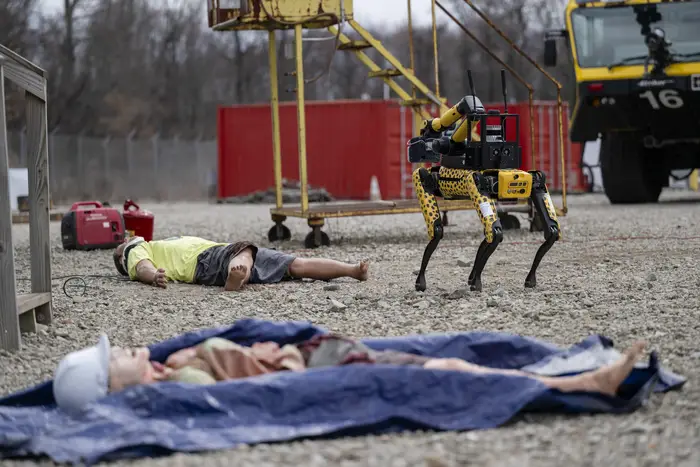
Carnegie Mellon University is developing coordinated AI drone swarms for the DARPA Triage Challenge, focused on rapid casualty assessment using remote vital-signs analysis while keeping responders out of hazardous zones. Multiple UAS scan and prioritize patients before ground teams enter. The mass-casualty SAR application is the most operationally relevant part of this work.
📋 Policy & Regulatory
Canada and Portugal Sign Aeronautical SAR Cooperation MOU
Canada and Portugal signed a Memorandum of Understanding on Aeronautical Search and Rescue Cooperation on July 12, coinciding with the completion of Advanced Search and Rescue Exercise (ASAREX) 2026 in Ponta Delgada, Azores. The MOU codifies cooperation mechanisms for cross-border aeronautical SAR incidents in the North Atlantic, including joint planning, information sharing, and coordinated responses. Signing day aligning with exercise completion is not coincidental: ASAREX exists to operationalize exactly the kind of cross-border coordination the MOU formalizes.
Nova Scotia Completes H125 Fleet Renewal for Wildfire and SAR Missions
Nova Scotia's Department of Natural Resources announced completion of its H125 helicopter fleet renewal, with aircraft tasked to provincial missions including wildfire response and search and rescue. Maintaining modern rotary-wing capability is a resourcing decision that rarely makes headlines until the old aircraft aren't available when needed.
🤔 Other News
Syria Advances INSARAG Urban SAR Certification at Global Meetings in Brazil
A Syrian delegation participated in INSARAG's 2026 annual meetings in Foz do Iguaçu, focusing on efforts to obtain international INSARAG classification for Syrian USAR teams. Getting a national team to international classification standards is a years-long process; the Syrians are in it.
🤓 And Now You Know
On the night of July 16, 1999, John F. Kennedy Jr. departed Essex County Airport in New Jersey in a Piper Saratoga with his wife and sister-in-law, bound for Martha's Vineyard. The aircraft entered haze over the water, descended from cruise altitude in a series of turns, and impacted the Atlantic approximately seven miles south of Gay Head. All three were killed.
The Coast Guard, Navy, and Air Force ran a three-day search before transitioning to recovery operations on July 19, pulling the wreckage and remains from 116 feet of water. The mission is a case study in two SAR challenges that rarely appear together: managing political pressure during a high-profile open search, and the formal decision to transition from rescue to recovery. Families almost never accept that transition without conflict, and the JFK Jr. case drew enough public attention that the call was made under the worst possible conditions for clear operational judgment. The NTSB attributed the accident to spatial disorientation, the third leading cause of fatal general aviation accidents. Today is its anniversary.
Have a story or some information you'd like posted in the SAR Times Weekly Newsletter? You can reach me via email, anytime.