Two New Search and Rescue Moves in Asia-Pacific Worth Watching
Australia is moving to refresh some rules, and Indonesia, Malaysia, and Singapore are putting more structure on some others.

Two recent developments out of Asia-Pacific deserve attention from the wider search and rescue community. One is technical and regulatory, with Australia moving to update its rules for helicopter operations on vessels. The other is regional and operational, with Indonesia, Malaysia, and Singapore sharpening trilateral coordination for cross-border aeronautical SAR under the MALINDOPURA framework.
Both point in the same direction. Rescue systems work better when the underlying rules are current and when neighboring states spend time building habits of coordination before a real emergency tests them.
Australia updates helicopter-operations rules
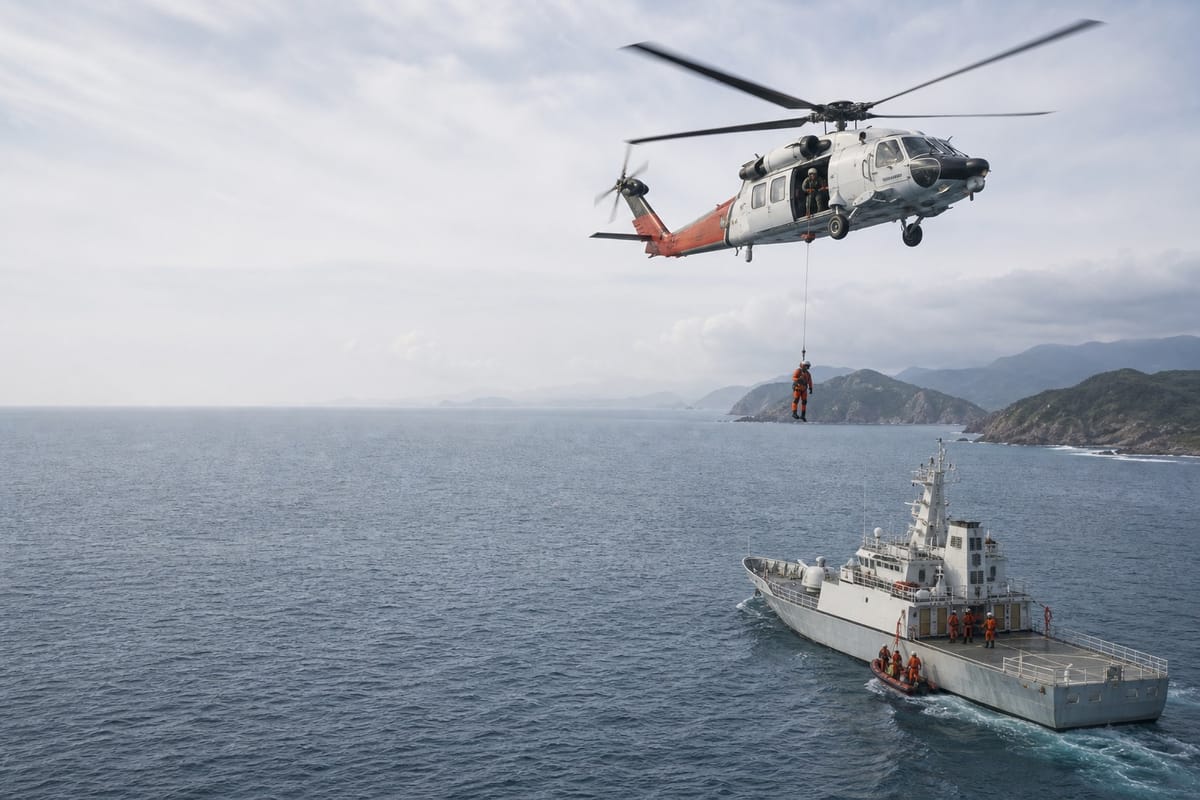
The Australian Maritime Safety Authority (AMSA) has completed consultation on proposed changes to Marine Order 57, the regulation that governs vessel-helicopter operations in Australian waters. The consultation closed on 4 May 2026, and AMSA says the revised order is scheduled to take effect on 1 October 2026, when the current instrument sunsets.
On paper, the changes are modest. AMSA says the revision updates references to match the latest edition of the International Chamber of Shipping's Guide to Helicopter/Ship Operations, refreshes definitions and cross-references to other marine orders, and makes minor terminology and formatting changes to keep the rule current and clear.
But small regulatory edits can have real operational consequences. Helicopter transfers are a routine part of offshore emergency response, including medical evacuations, personnel recovery, and support to maritime search and rescue. When the governing standard is aligned with current industry guidance, crews, vessel operators, and air assets have a better common baseline for planning and execution.
No, this isn't a chance that'll grab headlines. It matters later, when a night hoist, offshore medevac, or time-critical shipboard transfer depends on procedures and equipment standards that everyone already understands.
MALINDOPURA moves from concept to structure
The second development is regional. At ICAO's Asia/Pacific Aeronautical Search and Rescue Working Group meeting in early May, Indonesia, Malaysia, and Singapore presented an update on the MALINDOPURA Trilateral Search and Rescue cooperation initiative.
According to the ICAO paper, the initiative now includes a MALINDOPURA SAR Working Group led by BASARNAS in Indonesia, the Civil Aviation Authority of Malaysia, and the Civil Aviation Authority of Singapore. The stated aim is straightforward: improve interoperability and collective preparedness for cross-border aeronautical emergencies through regular cooperation rather than ad hoc coordination after an incident has already unfolded.
The framework is built around three practical areas. The first is capacity building through workshops, training programs, and personnel exchanges. The second is joint exercises to test procedures and improve coordination. The third is information-sharing, including lessons learned and operational best practices.
It is exactly the kind of work that determines whether a multinational SAR response runs smoothly or stalls at the seams. In aviation SAR, minutes matter, and confusion over roles, communications, or information flow can quickly become operational friction.
Why these two updates belong together
These are different stories, but they reflect the same truth about rescue readiness. Capability is built long before a distress call comes in. Sometimes that means updating a technical rule so crews are working from current guidance. Sometimes it means building a framework so neighboring states know how to work together when an aircraft disappears near a boundary or a search area spans multiple jurisdictions.
For SAR Times' international readers, and SAR professionals at large, both developments are worth watching because they sit below the level of breaking news but above the level of administrative housekeeping. Australia's Marine Order 57 update shows that safe helicopter-vessel operations depend on current standards. MALINDOPURA shows that cross-border SAR runs on relationships, repetition, and agreed procedures. Goodwill alone isn't enough.
Neither move, on its own, transforms SAR capability overnight. But both point to the kind of steady work that separates a capable rescue system from one that is improvising under pressure.
References
Australian Maritime Safety Authority. (2026, May 4). Proposed changes to helicopter operations on vessels. https://www.amsa.gov.au/news-community/consultations/open-consultations/proposed-changes-helicopter-operations-vessels
International Civil Aviation Organization. (2026, May 5–8). APSAR/WG/11 – IP/09: MALINDOPURA Trilateral Search and Rescue cooperation initiative [Information Paper]. ICAO Asia/Pacific Aeronautical Search and Rescue Working Group 11. https://www.icao.int/sites/default/files/APAC/Meetings/2026/2026%20APSARWG11/04-Information%20Papers/AI04%20IP09%20MALINDOPURA%20Trilateral%20SAR%20Cooperation.pdf