U.S. Coast Guard Formalizes the SAR Mission Manager: A Quiet Policy Shift With Loud Implications
Turning SAR Mission Planning from Collateral Duty into a Defined Competency

Policy Review | Issue: United States | May 5, 2026
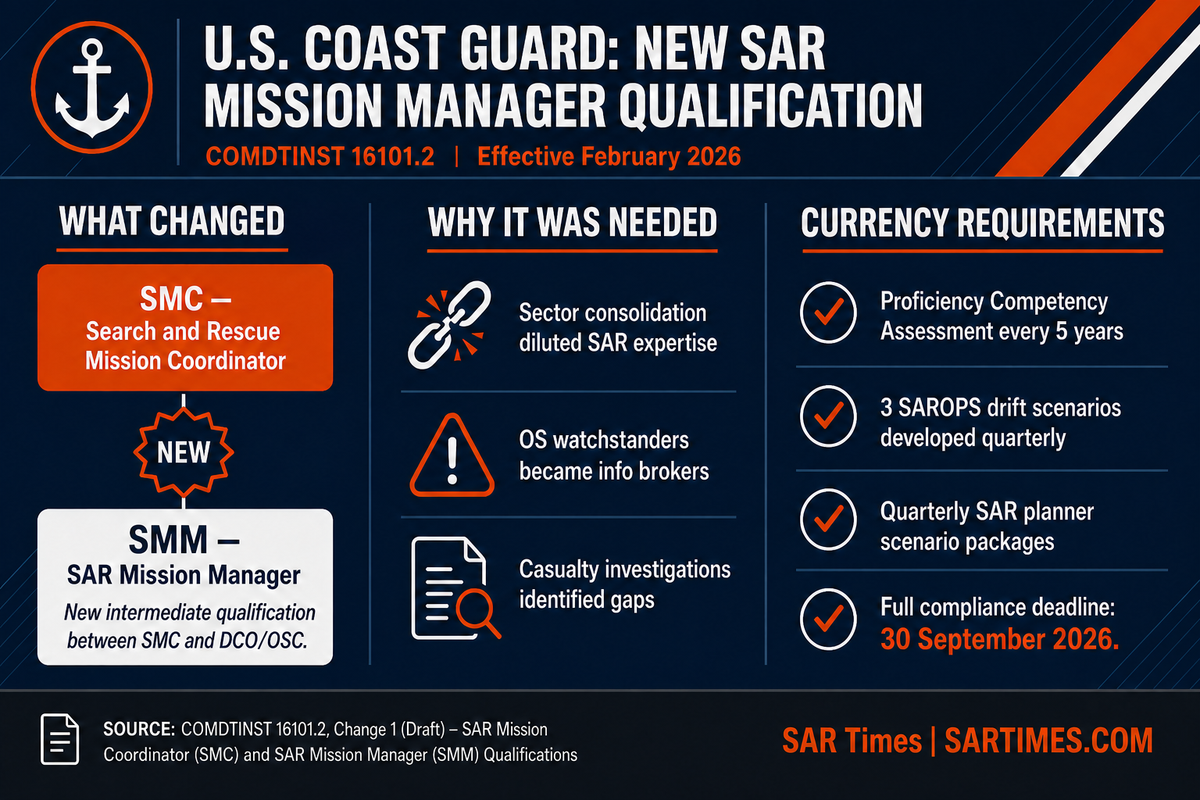
In early February 2026, the U.S. Coast Guard quietly signed one of the more consequential SAR doctrine documents in recent memory. COMDTINST 16101.2, titled Search and Rescue (SAR) Training and Competency Management, established a new formal qualification: the SAR Mission Manager (SMM). The instruction was promulgated service-wide via ALCOAST 037/26 on 1 March 2026.
On the surface, it reads like a routine administrative update. But the SMM represents something deeper, a formal acknowledgment that SAR planning expertise has been eroding inside the Coast Guard's Command Centers, and a concrete policy response to fix it.
I admit, as a former SMC myself, I didn’t quite understand the logic of the new qualification. However, after about two weeks of reading and research, I believe I’ve convinced myself it is indeed the right direction.
What Is the SAR Mission Manager?
The SMM is a codified watchstander competency assigned to personnel working inside Coast Guard Command Centers (CCs). By definition, an SMM is "an individual holding a competency to perform the duties of planning and coordinating a SAR operation in support of the assigned Search and Rescue Mission Coordinator (SMC)."
This is a meaningful distinction. The SMC (Search and Rescue Mission Coordinator) is the senior authority responsible for a SAR mission, typically a command-level officer who may be managing multiple priorities. The SMM sits on the watch floor, doing the actual case planning work (i.e., SAROPS drift modeling, resource allocation, initial response execution, and documentation). The SMM does not replace the SMC. The SMM theoretically enables the SMC to exercise command authority at the right level, rather than being pulled into execution-level tasks.
To qualify as an SMM, Coast Guard personnel must complete a dedicated Personnel Qualification Standard (PQS), minimum watch hours, specific coursework, and a formal knowledge evaluation. To stay current, they must complete a Proficiency Competency Assessment every five years, develop three SAROPS drift scenarios quarterly, and complete quarterly SAR planner scenario evaluations alongside their SMC. All existing SMC and SMM personnel must meet these currency requirements by 30 September 2026.
The Problem This Policy Is Solving
The SMM qualification did not emerge from a vacuum. It is the policy answer to a well-documented, years-long crisis in SAR expertise.
When the Coast Guard consolidated into sector commands in the early 2000s, it merged maritime safety, environmental response, law enforcement, and SAR into unified watch floors. The result was a multi-mission workforce stretched across more mission areas than staffing could support. Operations Specialists (OS), the primary rating responsible for SAR case management, increasingly became information brokers, routing tasks across mission areas rather than developing deep SAR planning expertise.
A 2021 article in U.S. Naval Institute Proceedings warned plainly that the OS rating was "at risk of collapse" from this dilution, and that the absence of enforced SAR-specific proficiency standards left Coast Guard Command Centers vulnerable to case management failures during complex, long-duration missions. Casualty investigations, including those examining the F/V PATRIOT sinking, had already surfaced gaps in the SAR chain of command that a cleaner separation between command authority (SMC) and execution expertise (SMM) would address.
COMDTINST 16101.2 is explicitly positioned within the Coast Guard's Force Design 28 initiative, which aims to push operational authority to the appropriate level. The SMM formalizes what practitioners had long argued: SAR mission planning should be a recognized primary specialty, not a collateral duty assigned to whoever is on watch.
How Does This Compare Internationally?
This is where things get interesting. The USCG's SMM competency appears to be without direct peer among its primary partner nations.
The IMO and ICAO jointly publish three IAMSAR Model Courses: Model Course 3.13 for SAR Administration, 3.14 for SAR Mission Coordinator, and 3.15 for SAR On-Scene Coordinator. These provide training curriculum frameworks, but they do not mandate national-level qualification standards, currency requirements, or ongoing proficiency assessments. They are "guidance" frameworks, not enforceable competency regimes.
United Kingdom: HM Coastguard qualifies watch floor personnel as Maritime Operations Officers (MOOs) under a broader apprenticeship standard developed by the Maritime and Coastguard Agency. The MOO standard encompasses SAR coordination, vessel traffic monitoring, counter-pollution, and coastal protection. It is explicitly multi-mission in design, with no discrete SAR Mission Manager tier or dedicated SAR-specific currency pathway sitting below the SMC level.
Australia: The Australian Maritime Safety Authority (AMSA) uses the SMC title in its National SAR Manual (2026 Edition), outlining the authority, responsibilities, and transfer protocols for SAR coordination. However, the NatSAR Manual does not define a separate sub-SMC watch-floor SAR planner qualification analogous to the SMM, nor does it prescribe currency requirements for watch-floor SAR planners comparable to those in COMDTINST 16101.2.
Canada, New Zealand, and others: Open-source doctrine and regulatory publications from these partners show similar patterns. For example, SAR coordination roles are defined at the authority level (SMC, OSC), with training addressed through IAMSAR-aligned courses rather than nationally enforced competency and currency standards.
The one exception worth watching is a development at the international level. In April 2025, the International Association of Search and Rescue Coordinators (IASARC) announced they are developing what is described as "the world's first international certification framework focused on the coordination of search and rescue." The planned framework will include certification tiers for SAR Administrator, SAR Mission Coordinator, and On-Scene Coordinator.
It is also worth noting that the IASARC SAR Communicators and Dispatchers certification exactly lines up with the SMM, giving future Coast Guard generations an opportunity to validate their skills and competencies with a globally recognized certification program. The certification program is still in development, which means no international standard exists yet. The USCG is, for now, out ahead of the field with an enforceable national-level competency.
Pros of the New Policy
Enforced proficiency baseline. By requiring quarterly SAROPS scenario development and five-year Proficiency Competency Assessments, the SMM standard creates a measurable floor for SAR planning capability that did not exist before. Command Centers can no longer graduate a watchstander as "SAR-capable" without documented competency evidence.
Cleaner chain of command. Separating the SMC (command authority) from the SMM (execution expertise) reduces confusion during complex cases. The SMC can focus on high-level decisions and resource authorization, while the SMM manages the planning and coordination workflow. This mirrors well-established principles in incident management doctrine.
Institutionalizing SAR as a specialty. Perhaps most importantly, the SMM formal qualification gives SAR planning professionals standing inside the USCG's qualification framework. It signals to the workforce that SAR mission management is a career-relevant specialty worth developing, not just a watch-floor collateral.
Alignment with Force Design 28. The SMM supports the broader organizational goal of appropriate authority delegation. Clearer role definition at the Command Center level enables district and sector commanders to push execution authority downward with greater confidence.
Potential for international standard-setting. As IASARC develops their global certification framework, the USCG's SMM model could serve as a practical reference for what a national-level SAR planner competency should look like.
Cons and Open Questions
Staffing and workload strain. The USCG has well-documented workforce challenges. Adding a distinct qualification pathway with mandatory currency requirements means Command Center personnel must dedicate time to scenario development, quarterly evaluations, and PCS cycle-independent recertification. For already-stretched watch floors, this creates a real burden without additional billets.
Transition friction. Legacy OS and CDO watchstanders were automatically given transition designations (OU-SMM or CDO-SMM) and given three years to complete full SMM requirements. During this window, Command Centers will have personnel at different competency levels operating in the same SMM role, which introduces inconsistency that the policy is designed to eliminate. And yes, I understand that it is nessesary, I'm only pointing it out.
The gap below the SMM. COMDTINST 16101.2 addresses the qualified planner level, but it does not eliminate the broader problem of multi-mission watch floor dilution. The OS rating still handles SAR, law enforcement, maritime safety, and environmental response in most Command Centers. The SMM competency addresses expertise, but not the structural competition for that expertise's attention.
No interoperability standard. Because no allied nation has an equivalent qualification, multinational SAR operations continue to lack a shared competency language. A USCG SMM working with a UK MOO or an AMSA SMC is operating from fundamentally different training assumptions. Joint operations still depend on IAMSAR framework familiarity rather than any reciprocal recognition of national qualifications.
The Force Design 28 wildcard. The full SAR policy modernization is anticipated to conclude in July 2026. COMDTINST 16101.2 is explicitly framed as a partial step. How additional revisions interact with the SMM competency, and whether the role expands or shifts, remains to be seen.
Bottom Line
The USCG's SAR Mission Manager qualification is a substantive and overdue policy move. It formalizes a distinction that SAR practitioners have long understood but that doctrine never enforced: mission command and mission execution are separate competencies requiring separate standards. Whether partner nations follow this lead, or whether the emerging IASARC framework absorbs this model into a global standard, will be worth watching over the next two to three years.
References:
- COMDTINST 16101.2, Search and Rescue (SAR) Training and Competency Management, U.S. Coast Guard, 2 February 2026: https://media.defense.gov/2026/Feb/03/2003870364/-1/-1/0/CI_16101_2.PDF
- ALCOAST 037/26, U.S. Coast Guard, 1 March 2026: https://content.govdelivery.com/accounts/USDHSCG/bulletins/407943b
- Wisniewski, R., "The Coast Guard Must Stop Diluting Maritime Search and Rescue Expertise," USNI Proceedings, November 2021: https://www.usni.org/magazines/proceedings/2021/november/coast-guard-must-stop-diluting-maritime-search-and-rescue
- IASARC/IPSQA Partnership Announcement, IPSQA, April 2025: https://ipsqa.com/iasarc/
- IMO/ICAO IAMSAR Manual Model Courses 3.13, 3.14, 3.15: https://www.amnautical.com/blogs/the-mariners-blog/what-is-iamsar-manual-and-its-purpose
- HM Coastguard Maritime Operations Officer Apprenticeship Standard, Skills England: https://skillsengland.education.gov.uk/apprenticeships/st0394-v1-0
- Australian NatSAR Manual, Volume 1, AMSA, February 2026 Edition: https://www.amsa.gov.au/sites/default/files/2026-03/NATSAR-Manual-February-2026-Volume-1.pdf