Vietnam's Decree 69/2026 ND-CP: Implications for Rescue Readiness
When the Environment Fails the Responder

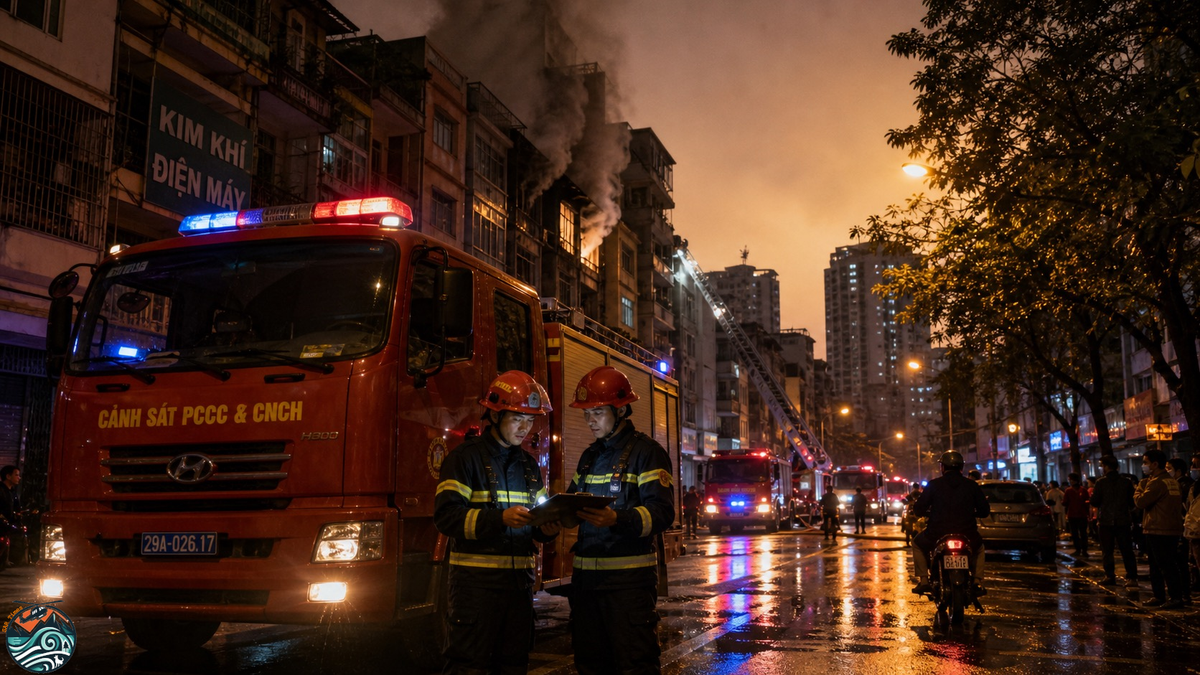
Policy Review | Issue: Vietnam | May 2026
Vietnam's new decree won't fund a single rescue. That's exactly what makes it worth reading and understanding.
Vietnam's Decree 69/2026 ND-CP is a technical update to the country's system of administrative sanctions for fire prevention, firefighting, and rescue. In practical terms, it is a policy effort to close the gap between nominal rescue capability and actual readiness. It does so through fines and enforcement authority rather than new funding. That distinction is the whole point. For SAR practitioners working in any jurisdiction, the real lesson here is not in the Vietnamese legal code. It's in the underlying question the decree forces: if your government removed the penalties for missing water reserves, undertrained facility managers, and non-compliant rescue vehicles, how much of your response environment would quietly degrade?
For search and rescue professionals, Decree 69 is useful because it shows how a government can use penalties to strengthen the ordinary conditions that shape rescue outcomes, including equipment availability, leadership training, and the built environment in which incidents occur.
What Decree 69/2026 ND-CP Does
Decree 69/2026 ND-CP amends Decree 106/2025/ND-CP, which governs sanctions for administrative violations in fire prevention, firefighting, and rescue. It does not create a new legal framework from scratch; rather, it adjusts the sanctioning powers where earlier implementation appears to have been weak or unclear.
Several changes are especially relevant to rescue readiness. The decree increases fines for specialized motor vehicles used for firefighting, rescue, and relief when they are equipped with non-compliant or substandard equipment, with penalties of 30 million to 40 million VND, or roughly $1,140 to $1,520 USD. It also introduces or highlights penalties of 3 million to 5 million VND ($115 to $190 USD) for failing to maintain required firefighting water reserves or basic, commonly used firefighting equipment and rudimentary demolition tools. Sanctions related to mandatory fire and explosion insurance are also expanded, including cases in which insured objects are incomplete or underinsured relative to legal requirements.
The decree also addresses training and establishment-level leadership. Under the revised provisions, organizations and individuals using certain personnel for fire prevention and rescue tasks without written notification of training results may face fines of 6 million to 8 million VND ($230 to $305 USD). This matters because the decree treats preparedness not only as a hardware problem, but also as a training and competency problem.
The decree further clarifies enforcement authority. Government summaries note that on-duty police officers have explicit authority to impose fines of up to 5 million VND ($190 USD) for certain violations, complementing the role of specialized inspectors. Commentary from Vietnamese government and media sources places Decree 69 within a broader sequence that includes Decree 105/2025, which detailed the Law on Fire Prevention, Firefighting, Rescue and Salvage, and Decree 106/2025, which established the initial sanction schedule.
Why It Matters for Rescue Readiness
At first glance, these provisions appear as routine fire code adjustments. From a rescue perspective, however, they affect some of the most important determinants of operational success in dense urban and industrial settings, determinants not unique to Vietnam.
In Vietnam, as in many other countries, fire and rescue services often carry a combined role rather than operating as a separate SAR agency. The difference between a department that has properly equipped vehicles, maintained water supplies, and trained leadership and one that only meets those standards on paper can determine whether an extrication succeeds or whether responders stall while improvising. By sanctioning substandard rescue equipment and missing basic rescue tools, Decree 69 addresses the material conditions that shape how quickly responders can act once they arrive. Any SAR team leader who has shown up to a scene and found a promised resource missing will recognize exactly what the decree is trying to prevent.
The financial penalties are meaningful as deterrents, but they should not be mistaken for a financing mechanism for SAR operations. A fine of 30 million to 40 million VND may be enough to influence compliance behavior for some establishments, yet it is far below the level required to build or sustain a serious rescue capability. In that sense, the decree functions as a deterrent against neglect and noncompliance, not as a mechanism that can independently close major resource gaps in equipment, training, or response infrastructure.
Human Capital and Leadership
One specific feature of Decree 69 is its attention to the training of establishment heads. Vietnamese legal and media explanations indicate that managers or designated personnel who lack the required professional training documentation may face fines in the 6 million to 8 million VND range.
This matters because many incidents are shaped before professional responders arrive. The decisions made by a factory manager, mall director, or warehouse supervisor in the first minutes after detection of a fire or structural failure can either reduce or increase the burden on later rescue forces. Sanctioning the absence of required training pushes organizations to verify that leaders understand alarm procedures, evacuation routes, initial rescue measures, and their responsibilities to coordinate with fire and rescue services.
From a rescue standpoint, trained leaders are also more likely to maintain accurate information that responders need, such as occupancy levels, hazardous materials, and the location of confined spaces. That can shorten the time between arrival and effective action, even if the decree itself is written in enforcement language rather than operational doctrine. The question worth asking elsewhere: does your jurisdiction require equivalent documentation, and is there a real consequence if it's missing?
Built Environment and EV Risk
Government summaries of major policies taking effect in April 2026 specifically highlight how Decree 69 addresses violations in areas with centralized electric vehicle charging or similar high-energy installations. In these settings, missing or inadequate fire prevention and rescue measures may trigger fines of 40 million to 50 million VND ($1,520 to $1,900 USD).
This is important because EV-related fires and similar incidents often require longer suppression times, specialized tactics, and careful management of toxic smoke. They also frequently occur in garages, basements, and other enclosed spaces where evacuation routes are limited and ventilation is constrained. When these environments are not adequately equipped, the burden on arriving fire and rescue crews increases significantly. The EV charging risk is not a Vietnamese problem. It is a 2026 problem for any team operating in built urban environments.
The same logic applies to other high-occupancy or high-risk structures, including entertainment venues and industrial facilities. By increasing sanctions for missing water reserves, missing systems, or incomplete firefighting and rescue equipment, the government is working to make the conditions into which SAR forces deploy less hostile and more manageable.
Enforcement on the Ground
Sanctions only matter if they are enforced consistently. Explanatory coverage of Decree 69 emphasizes that ordinary People's Police officers on duty now have clearer authority to deal with certain fire and rescue violations, including fines of up to 5 million VND and seizure of relevant items.
This is relevant because many of the violations that create serious rescue problems are not discovered during formal inspections by specialized units. They are often visible in daily life: blocked exits, unsafe electrical arrangements, missing equipment, or conditions that compromise evacuation and response. Giving ordinary officers the ability to intervene lowers the threshold for correcting these hazards before they become operational constraints.
At the same time, this approach depends on careful implementation. There is a risk that enforcement will focus on easier targets while larger and more complex premises receive less attention. For rescue practitioners anywhere, the real question is the same regardless of country: do enforcement patterns align with actual risk, or do they simply produce more citations?
Insurance Readiness
Decree 69 also intersects with rescue readiness through its treatment of mandatory fire and explosion insurance. Underinsured or improperly insured objects are treated as sanctionable violations, closing a gap left ambiguous by earlier rules.
Although insurance may not seem like a direct SAR issue, it contributes to the long-term sustainability of rescue capability. When major assets and high-risk facilities are properly insured, there is more financial capacity to replace damaged infrastructure, restore operations, and improve preparedness after an incident. Insurers also gain more standing to require risk reduction as a condition of coverage.
If facilities remain underinsured and rely heavily on public rescue services without contributing to the cost of risk, the burden of maintaining readiness falls disproportionately on public resources and volunteer effort. Decree 69 does not solve that problem through funding, but it does try to discipline it through sanctions.
Broader Lessons for SAR
Although Decree 69 is specific to Vietnam's legal system and recent fire incidents, it offers several broader lessons for SAR communities elsewhere. It shows how monetary sanctions can be used to address the routine but essential components of rescue readiness, such as water reserves, hand tools, vehicle outfitting, and basic training.
It also highlights the value of aligning multiple legal instruments. In this case, the substantive duties are established by the law, implementation details are clarified through Decree 105, sanctions are set by Decree 106, and Decree 69 adjusts those sanctions based on implementation experience. For jurisdictions with fragmented frameworks, that sequence offers a useful model.
The decree also reinforces the idea that rescue depends on dedicated teams but is also shaped daily by workplaces, residential buildings, and infrastructure nodes. The effects of the decree will be felt most at the moment when responders arrive and discover whether the environment is helping or hindering them.
Open Questions
Decree 69 raises several questions worth monitoring. Will the higher fines and expanded enforcement powers produce sustained improvements in equipment quality and training, or will they encourage surface-level compliance only? Will smaller communities and low-resource establishments be able to meet the new standards without sacrificing other safety priorities?
Another question is whether Vietnam will publish enough outcome data to evaluate whether the decree reduces incident severity and improves rescue performance over time. If that feedback loop develops, the decree could become not only a legal instrument but also a learning tool for the wider fire rescue community.
Vietnam has chosen to treat rescue readiness as a regulatory issue with financial consequences. Those consequences are designed as fines to compel compliance, not as a funding stream for SAR services, and grasping that distinction is central to understanding what the decree can and cannot realistically accomplish. For teams outside Vietnam, the fine amounts don't travel. The checklist does. If your jurisdiction has no equivalent sanction for missing water reserves, non-compliant rescue vehicles, or undertrained facility managers, the gap that Decree 69 is trying to close is almost certainly present in your response area too.
References
Bộ Chính Phủ. (2026). Major policies take effect from April 2026. https://en.baochinhphu.vn/major-policies-take-effect-from-april-2026-111260401101524739.htm
Lao Dong News. (n.d.). Failure to maintain fire water reserves will be fined up to 5 million VND. https://news.laodong.vn/tu-van-phap-luat/khong-duy-tri-tru-luong-nuoc-chua-chay-bi-phat-den-5-trieu-dong-1667340.ldo
Lao Dong News. (n.d.). Failure to maintain sufficient common fire fighting equipment will be fined. https://news.laodong.vn/tu-van-phap-luat/khong-duy-tri-du-phuong-tien-chua-chay-thong-dung-bi-phat-den-5-trieu-dong-1668548.ldo
Lao Dong News. (2025). A series of violations in fire prevention and fighting have had their fines increased from July 2025. https://news.laodong.vn/tu-van-phap-luat/loat-vi-pham-trong-phong-chay-chua-chay-duoc-tang-muc-phat-tien-tu-thang-72025-1544384.ldo
LuatVietnam. (n.d.). Decree 105/2025/ND-CP detail law on fire prevention, firefighting, rescue and salvage. https://english.luatvietnam.vn/an-ninh-trat-tu/decree-105-2025-nd-cp-detail-law-on-fire-prevention-firefighting-rescue-and-salvage-400511-d1.html
LuatVietnam. (n.d.). Decree 106/2025/ND-CP sanctioning of administrative violations of fire prevention and fighting. https://english.luatvietnam.vn/dat-dai/decree-106-2025-nd-cp-sanctioning-of-administrative-violations-of-fire-prevention-and-fighting-400568-d1.html
Thư Viện Pháp Luật. (n.d.). Decree 69/2026/ND-CP in Vietnam, Decree 69/2026/ND-CP amendments to Decree 106/2025/ND-CP. https://thuvienphapluat.vn/van-ban/EN/Vi-pham-hanh-chinh/Decree-69-2026-ND-CP-amendments-to-Decree-106-2025-ND-CP/699320/tieng-anh.aspx
Vietnam Trade Union (Cong Doan). (n.d.). Police officers have the right to fine up to 5 million VND in fire prevention and fighting. https://en.congdoanvietnam.vn/tu-van-phap-luat/chien-si-cong-an-co-quyen-phat-den-5-trieu-dong-trong-phong-chay-chua-chay-28201.tld
Vietnam Trade Union (Cong Doan). (n.d.). Failure to maintain fire water reserves will be fined up to 5 million VND. https://en.congdoanvietnam.vn/tu-van-phap-luat/khong-duy-tri-tru-luong-nuoc-chua-chay-bi-phat-den-5-trieu-dong-27982.tld
Vietnam.vn. (n.d.). Equipping with substandard fire-fighting equipment can result in fines up to 40 million VND. https://www.vietnam.vn/en/trang-bi-phuong-tien-chua-chay-khong-bao-dam-co-the-bi-phat-toi-40-trieu-dong
Vietnam.vn. (n.d.). Key new policies that will take effect from April 2026. https://www.vietnam.vn/en/nhung-chinh-sach-moi-noi-bat-co-hieu-luc-tu-thang-4-nam-2026
Vietnam.vn. (n.d.). Revise the penalties for fire safety violations. https://www.vietnam.vn/en/sua-doi-cac-muc-phat-vi-pham-phong-chay
Vietnam.vn. (n.d.). Strengthening fire safety regulations: Key new points in administrative sanction regulations under Decree 69/2026/ND-CP. https://www.vietnam.vn/en/siet-chat-ky-cuong-phong-chay-chua-chay-nhung-diem-moi-quan-trong-trong-quy-dinh-xu-phat-hanh-chinh-theo-nghi-dinh-69-2026-nd-cp
Vietnam Briefing. (2026). Vietnam Regulatory Updates: Key Changes Effective April 2026. https://www.vietnam-briefing.com/news/vietnam-regulatory-update-key-changes-effective-april-2026.html/